Farm Operations Management
Causes and fixes for legginess: reading density, light, night temperature, and humidity from how the seedling looks
Articles for Farm Operations Managers
When legginess shows up, the first thing most people look for is “how do I stop it.” Should I add light, lower the night temperature, or is it humidity? But if you start from how to stop it, you usually freeze up. The candidate causes cannot be narrowed down from the look alone.
Try changing the order. Before you stop it, first read it. A stretched stem is a signal the seedling is putting out in response to the conditions it has been placed in. How densely you sowed into the tray, which cell you grew it in, what the cultivar is——and whether the leaves are thin, whether only the internodes have stretched, on which shelf and when it shows up. What has slipped is written right there.
This article assumes leafy greens in a PFAL (closed-type, multi-tier LED cultivation). That is also the range I have seen on the floor. Sunlight-type greenhouses and fruiting vegetables are different in how light comes in and how transpiration moves, so this does not transfer directly. Instead, see legginess not as “a symptom to stop” but as “a signal about conditions.” And the order in which you read is density first, then environment. That is where we start.
With legginess, suspect density first, then read the environment
A seedling stretches up thin and spindly. This is what we call legginess. It falls outside the shipping grade and hurts the share of marketable plants. And that is not all. In leafy greens, legginess can drop the weight of the harvest, and the cell walls thin out, leaving the plant weaker against disease. It looks unremarkable, yet it chains through to both yield and quality. When legginess shows up, you are tempted to reach straight for an environmental knob—“now, how do I stop this.” But before that, there is an order in which to look.
The first thing to suspect is not the environment. It is cultivar, seeding density, and cell count. Under the same environment, a cultivar prone to stretching will stretch. Sow densely into a tray, and the crowding among neighboring plants itself promotes the shade avoidance described later. The cell count of the plug tray (say 72, 128, or 200 cells) is not just “how many you can produce” but governs “what kind of seedling you get.” The smaller each cell, the less room the roots have to spread—and that works against you more, the longer the crop’s propagation period. Even within the range I have seen on the floor, plenty of legginess turned out to be explained—before agonizing over the environment—by “is that tray simply oversown, are the cells too small.” So first, get cultivar, density, and cell count in order. That is the first tier.
On top of that, what still remains is the range you can read with the environmental knobs—the three factors of light, night temperature, and humidity. Put the other way, when density or cultivar is the real cause, no amount of turning the three environmental factors hits the mark. If you think of it only as “legginess = the three of light, night temperature, and humidity,” you skip the first tier that matters most. So the order is density first, environment after. The factors that drive legginess are not even exhausted by these two tiers—nutrients, the growing medium, and how the seedling is raised come into it too—but as the levers you can actually move on the floor, going at them in this order is the practical approach.
Legginess is not a symptom to stop but a signal about the environment
Having gotten density and cultivar in order, from here we read the legginess that still remains as a signal about the environment. Legginess is far easier to grasp when you see it less as something to stop and more as a signal the seedling puts out in response to something in its environment.
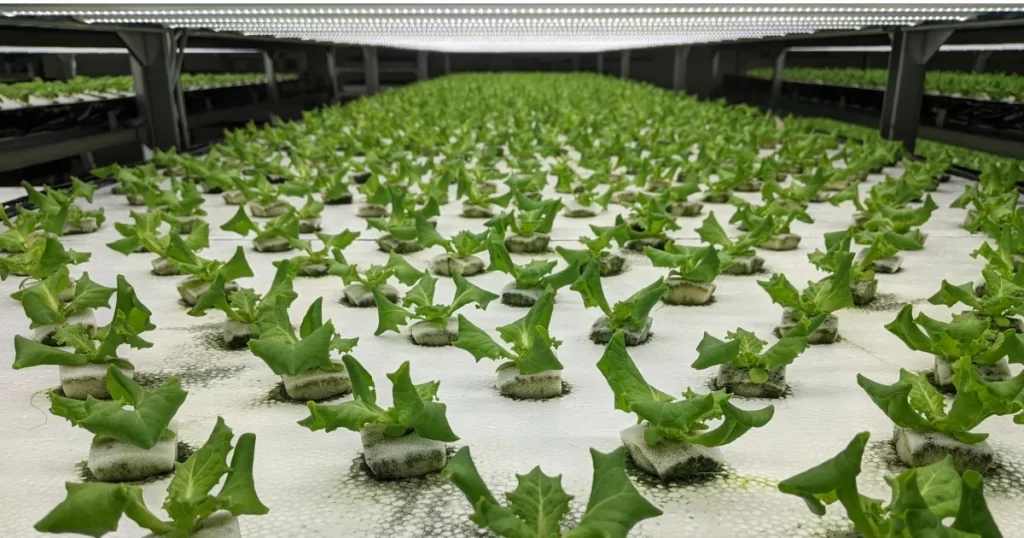
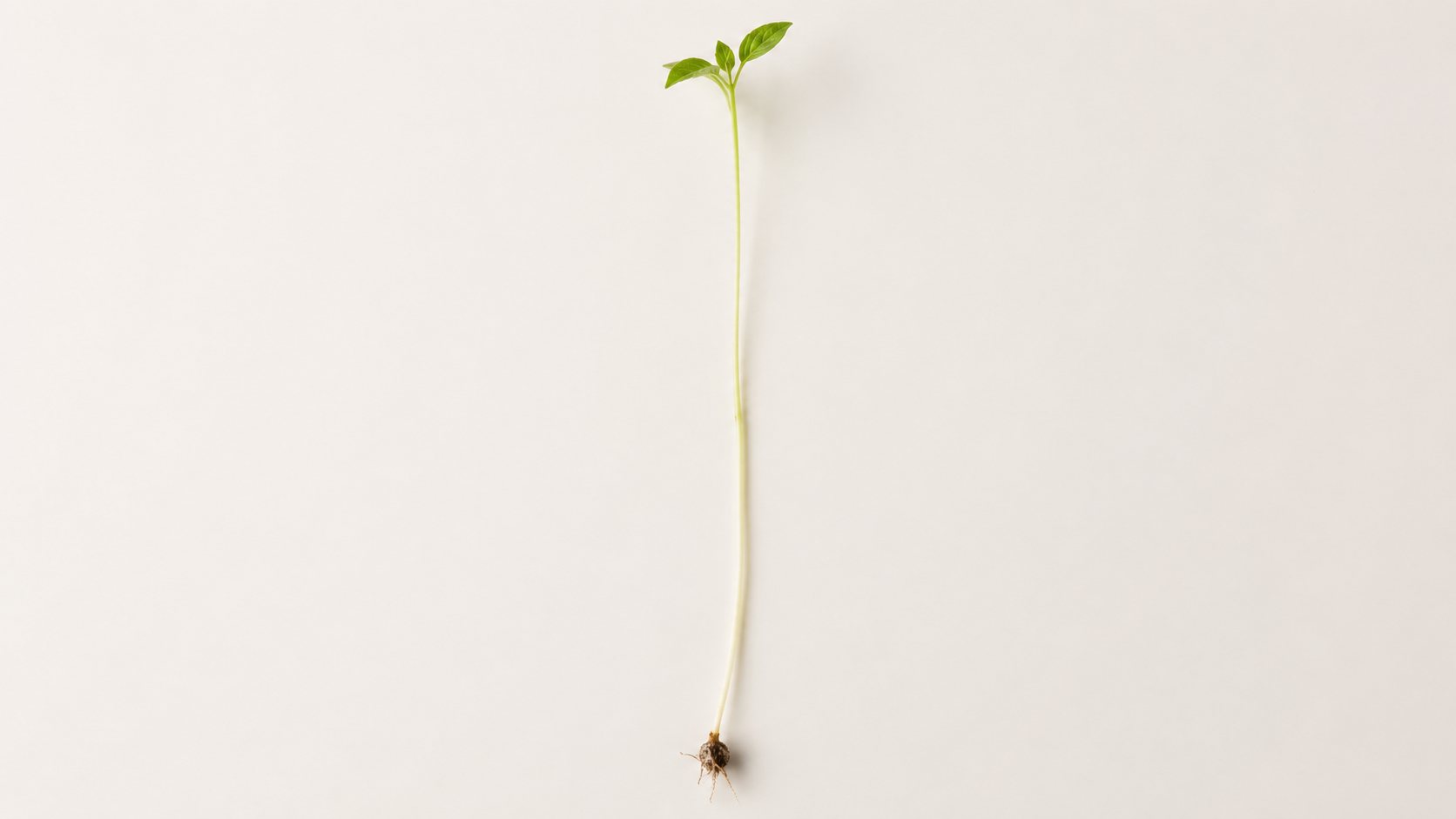
When you notice legginess in a plug tray, there is usually an order to it. Before you look at the whole tray and feel “huh, these are tall,” what catches your eye is the stem between the cotyledons and the true leaves—the hypocotyl—stretched up oddly straight and overlong. In the early stage of propagation, the stem stretches before the leaves do. The leaves have not changed much in size, yet only the stem is long—that is how it looks. And even on the same shelf, it shows up differently on the upper and lower tiers, and there are times when it is more prone to appear. Rather than random, it starts to look like there is some pattern to it.
This “in the early stage the hypocotyl stretches first” is one of the things worth reading. At this stage, where the leaf area is still secured and only the stem is running ahead, the stem length is easy to read as the seedling’s reply to its light environment. The difference between the upper and lower tiers is the same. Even under the same LED, the light intensity received changes with shelf position, so the weaker side stretches in reply. Even if the room’s set temperature is constant, if how the temperature falls after the LEDs are dimmed at night, or how well dehumidification works, differs by shelf, that too shows up in the stem. Which shelf’s seedlings are reacting most strongly to what becomes visible through the stem.
That said, this is the early-stage look. When legginess progresses, or when light shortage is the main cause, the look changes. As we touch on later, as it progresses the leaves themselves get smaller and thinner, and the color pales too. “Only the stem is long” is an early-stage sign; “thin and pale all the way to the leaves” is a sign on the progressed / light-shortage side—it is practical to read them split out by stage.
The stem stretches because the seedling senses light and reacts. When it is crowded and shaded by a neighbor’s leaves, the ratio of far-red light to red light rises. A light sensor called phytochrome detects this and, by way of hormones such as auxin, elongates the stem. It is explained as the reaction known as shade avoidance (see 1, 2). The stem also tends to stretch when light itself is weak, but you cannot simplify it to “the weaker the light, the more it stretches uniformly.” Too much blue light can also make it stretch, for one—the look is not determined in a single direction, but by the combination of the quantity and quality of light. What is certain is that light intensity itself governs the seedling’s growth and form, and this is something multiple studies show in common (see 3, 4, 5, 6). The color (quality) of light affects form too, but that is organized in terms of the red-to-far-red ratio and the workings of blue-light receptors (see 2).
Telling light shortage from night temperature by how the seedling looks
The seedlings on the lower shelf are stretching more than those on the upper. On the cultivation rack, the first thing that comes to mind is light intensity—the lower shelf can be more prone to stretching. On the other hand, even when the LEDs are dimmed at night, on the lower shelf the HVAC that brings the night temperature down can work weakly, so warmth stagnates and the night temperature never fully falls. Faced with these two, have you ever wondered whether you can tell, from the look alone, whether it is stretching because the light is weak or because of the night temperature? If both end in the same result of the stem stretching, it seems you cannot distinguish which one the seedling is reacting to.
The clue lies in how it looks apart from the stem. It cannot be cleanly separated out, but it does serve as a rough guide for placing your bet. A seedling stretching because the light is weak tends to grow a longer stem but thinner, paler leaves. You could call it a posture of throwing its body toward the light. On the other hand, when it stretches because the night temperature never fully falls and warmth stagnates, the leaves keep a fair amount of thickness and color while only the stem’s internodes stretch. And this one is more prone to appear when the place—the lower shelf—and the time—nighttime—line up together. In other words, on top of the look itself, when you read it together with when, where, and how the leaves are, you get a sense of which one is likely the strongest factor. Thin and pale all the way to the leaves leans toward light; leaves normal with only the internodes stretched leans toward night temperature. The idea is to rank your hypotheses by priority that way.
There is one thing I want to set down here. This way of telling them apart is not “a tool for confirming the main cause” but “a rough guide for prioritizing what to suspect next.” When several factors are off at the same time, the look does not split out the way the textbook says. The lower shelf in particular is a place where light, night temperature, and dehumidification all tend to go weak at once—it splits ambiguously exactly where you most want to use it. So when it splits, do not lock onto one; as we touch on later, the move is to ease all three toward the safe side together.
How humidity shows up, and the order in which to move your responses
Humidity should not be overlooked either. In a PFAL, humidity keeps rising through transpiration, so you are always dehumidifying, but if there are time slots or shelves where the dehumidification works weakly, that too feeds into the stem stretching. Light, night temperature, and humidity work less separately than tangled together. As noted earlier, these are the three environmental factors you read off what still remains after getting cultivar, density, and cell count in order.
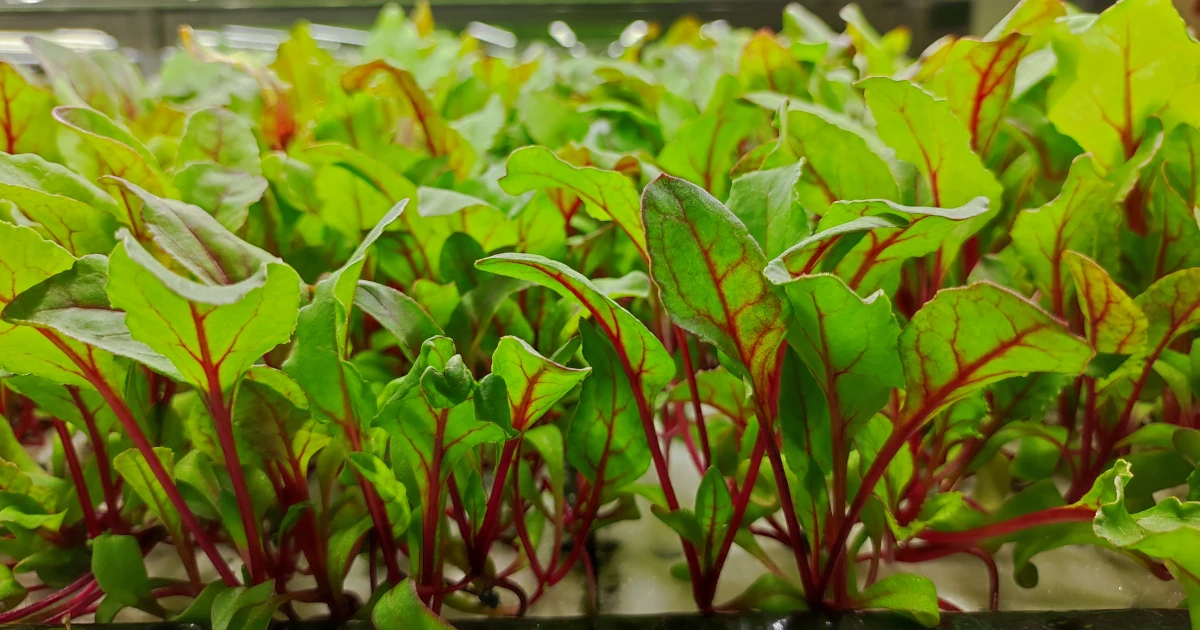
So how does humidity show up in the look? Humidity seems to show up in how the leaves look and in unevenness across time slots, more than in the stem itself. In time slots or on shelves where dehumidification works weakly, transpiration stops and the seedling no longer moves water. Then the leaves stay turgid, growing a bit large and soft, and under them the stem stretches loosely. Unlike the “thin and pale” of light shortage and the “only the internodes” of night temperature, the marker is that it tends to appear in a cluster on damp, stagnant shelves and time slots. Rather than looking at humidity on its own, it is easier to organize when you grasp it as vapor pressure deficit combined with temperature. That vapor pressure deficit governs transpiration has been organized as a mechanism in research on fruit vegetables and greenhouse management (see 7, 8).
One caution. These studies showed, in greenhouse tomatoes, what you could call a good direction—“lowering vapor pressure deficit (raising humidity) opens the stomata, photosynthesis advances, and yield increases.” The bad direction I am writing about here—“when damp stagnates and transpiration stops, the leaves stay soft while the stem goes loose”—is not directly supported by the source. The mechanism up to the earlier point—“humidity (vapor pressure deficit) governs transpiration”—is in the paper; from there on, the causation “transpiration stops -> stretches weakly” is something I write as an on-the-floor inference from watching leafy greens in a PFAL. The type and the crop are different, so treat it as borrowing the mechanism to read the situation.
There is one thing I want to separate out here. What to do about the current crop that is already stretching, and not producing the same legginess in the next crop—these are different matters. A seedling that has already started stretching is a race against time, and if you move only after narrowing the cause down to one, the stretch advances in the meantime. So for the legginess showing up now, lean everything to the conservative side without waiting to pin down the cause. That is: lift the light, lower the night temperature, strengthen dehumidification. This move is the realistic one. But moving suddenly and largely is itself a stress, so do it in steps. And pushing light even higher on a shelf that already has enough light can backfire. More light is not always better; past a certain point, adding it does not raise yield, and there is even a band where it drops instead. What needs lifting is the weak shelf, not the shelf that already has enough.
Where reading to narrow the main cause down to one comes into its own is, rather, toward the next crop. Line the upper- and lower-shelf seedlings up side by side in the morning and compare them, and the difference between shelves can be read on the spot. Look at stem length, leaf color and thickness, and leaf softness, and get a sense of which one is replying in the loudest voice. Then move the one suspect in the next lot and watch how the look changes, and you can confirm the main cause. Fiddle with all three within the same crop and you lose track of which one took effect. Confirming them one at a time is meaningful precisely across separate lots.
That said, even if you work out the optimum value of each environmental element separately and add them up, you cannot fully predict the result when you move them at once. Because the variables interact, the optimum value varies across the literature and the growth stage. Even for a single element, there are not numbers you can assert as the one and only optimum (see 9). That is exactly why you do not finish confirming in one go; you tighten it up little by little, crop after crop. That is what is realistic.
Measures for lifting the light on weak shelves
I have written “lift the light” and “lift the weak shelves,” but then how, concretely, do you lift it? Add lighting blindly and all you grow is the electricity bill. Switching from the mindset of “more light = higher electricity bill” to the side of “fix the quality and distribution of light efficiently” is the entry point to making energy savings and legginess prevention work together. Let me list a few, in order of return on investment.
The first is reflective material. Raising the reflectance inside the facility and on the shelves lets you deliver more light to the plants with the same lighting equipment. It works well for its low cost, and applying reflective sheeting to the sides of the shelf lets light in from the sides too, improving the light environment on the middle and lower tiers. Even within the range I have seen on the floor, before adding new lighting, I often first checked how far reflection could get me.
The second is the height and distribution of the lighting. With LEDs, if the spacing opens up too far, a weak band forms between the illuminated zones. Overlap the illumination so the lighting spacing does not open too wide, and make light arrive not just from straight overhead but at an angle and from the side, and the light unevenness within the shelf decreases and reaches all the way to the lower tier. Legginess shows up at “the weakest spot” rather than at “the average light level,” so evening out the unevenness is itself a way to lift the light.
If that still is not enough, you step up: use intermittent lighting to hold down power while tuning light quality, add supplemental lighting equipment, and so on. As an order, start from the low-cost side—reflective material, proper density, adjusting lighting height—watch the effect, and move to supplemental lighting if needed. Do not start straight from capital investment.
With a stretched seedling, the response changes by stage
How do you handle a seedling that has already shot up? This is what realistically worries you. Suppose you figure out the cause and fix the environment—does the stretched hypocotyl shrink back to its original length? Or once it stretches, is it gone for good and you just have to give up on it for the shipping grade? If it can be recovered, up to what stage are you still in time?
First, as for the stretched hypocotyl itself, within the range I have seen on the floor it has never tightened back to its original length. A stretched internode does not shrink. You are better off not expecting it there. But rather than sorting it into recoverable / not-recoverable, it is more usable on the floor to see it as the meaning of the response changing by stage. If the stretch is still in the early hypocotyl stage and the true leaves are about to expand from here, fixing the environment is well worth it. You can stop the internode stretch from here on, and there is still room to rebuild the form on the true-leaf side that stacks up above. The stretch already in stays, but this is a stage where you can plausibly get it back onto grade.
On the other hand, if the internodes have already stretched and it is leaning over, and the true leaves too are starting to expand carrying that stretch forward, then writing this plant off against the grade also comes into play. The basis for judgment is not the true-leaf stage alone. Are the growing point and the roots still alive? Where in the growth cycle is it? In an early propagation stage, replanting can be efficient; if harvest is close at hand, there are cases where it pays more to manage it as a leggy plant and harvest it rather than forcing a rebuild. Keep the core of the line at “whether the true leaves carried the stretch forward,” while combining the life or death of the growing point and roots and the stage of the crop cycle, and extend the judgment out toward the latter half of growth.
The reason the stretched stem itself does not go back is that form gets fixed during the period it is being built. As a similar example—in a different crop, granted—there is a report that in roses the function of the leaf (its stomata) gets fixed by the environment during that leaf’s developmental period, and is hard to reverse afterward even by changing the environment (see 10). The crop and the organ are different, but the tendency for form to be fixed during the period it grows and to be hard to reverse afterward can be applied to a leggy internode as well. The stretched stem itself does not tighten, but the value of your response points toward the side of stopping the stretch from here on and not producing it in the next crop.
Pre-seeding checkpoints so it does not show up in the next crop
If the stretched stem does not go back, the value of your response is, after all, on the side of “do not produce it in the next crop.” So before seeding, what should you check to reduce mishaps? So as not to leave a crop’s response at “correction after it shows up,” from here we shift our eyes to the preparation done before it shows up.
The order of checking is the same as it has been. Density first, then environment.
First, seeding density and cell count. If seeding density is high and it crowds against neighbors, that itself promotes shade avoidance. Against the seedling form you are aiming for and the propagation period, is the tray’s cell count (72, 128, 200 cells, and so on) too small? The longer the propagation period of the crop, the more leaning toward a tray with larger individual cells lowers the legginess risk. When the canopy gets too crowded and light no longer reaches the lower leaves, the legginess risk rises. When neighboring plants’ leaves start to overlap, or the lower leaves start to yellow, it is time to thin out or transplant. These are things to nail down shelf by shelf before seeding, as part of how you build the propagation.
On top of that, check the three environmental factors before seeding.
For light, measuring the light level at each shelf position before seeding comes first. Even with the same LED, the lower shelf can have a reduced reach, and the weak shelf replies with stretch. Nail down in numbers whether the lower shelf is below the standard, and the variation across shelves.
For night temperature, look shelf by shelf at how the temperature falls after lights-out. Even if the room’s set temperature is constant, on the lower shelf the HVAC that brings the night temperature down at night works weakly and warmth tends to stagnate, and a night temperature that never fully falls is a trigger that stretches only the stem. Before seeding, check the lower shelf’s temperature trajectory after lights-out.
For humidity, check in advance whether there are time slots or shelves where dehumidification works weakly. The times and places where damp stagnates are where the reply of the stem stretching while the leaves stay soft is easily called up.
Get density and cell count in order, and—because these three show up tangled together—do not assume fixing just one factor will stop it. Before seeding, write out shelf by shelf the “shelves and times where mishaps are prone to happen,” alongside density and cell count. Then, rather than scrambling after legginess shows up, you can read the weak spots and prepare before it shows up.
Legginess is not something you “fix after it shows up”—it is something you read in advance, working out which shelf is weak for which reason before it shows up. Rather than blaming the stretched stem, suspect density first, and read what still remains as a signal about which setting the seedling is replying to. Once you think of it that way, the eye you bring to the tray each morning should change a little.
Legginess ties directly to yield. How you combine and read density, light, night temperature, and humidity is, just as it stands, a story about the profitability of a vertical farm. If you want pointers you can use on the floor more broadly, this is for you too.