Industry Trends
Singapore and Dutch Vertical Farms: Japan's Gap Is Sales
2026-06-11
When you sit in front of the success stories of vertical farms in Singapore or the Netherlands, the question tends to take the shape of “which country do I copy to win?” You rank the countries and import the one in first place - it’s a tidy way to organize things, which is exactly why thinking stops there. But the real reason the leading hubs took off lay not inside the facility, but in that country’s electricity prices, subsidy schemes, and distribution practices. If so, what you should be looking at is not the country ranking, but the line between which of those conditions can be reproduced in Japan and which cannot.
An overseas hub’s success is made by location conditions, not the facility
Have you ever had your hand stop while reading a site-visit article about a Singapore vertical farm? The lettuce yield is high, the years to payback are short, it all looks impressive, and you start to think “what if I did this in Japan?” Then it suddenly hits you that the assumption about electricity costs is different, and the hand that was about to copy the numbers into your plan stops. The difference in premise there is that this is a country that positions food self-sufficiency as a matter of national security. You were reading it as a story about facility performance, but it was actually a story about the country’s finances.
A driving force other than efficiency is at work here. It’s not “we do it because we make more money doing it,” but “we do it because we can’t eat if we don’t.” In a country where open-field farming barely works and most of its food is imported, indoor cultivation becomes not a tool for efficiency but food security itself, and demand arises not from the market but from national security. Singapore’s vegetable self-sufficiency rate sits at around three percent, and the government has set out “30 by 30,” aiming to produce 30 percent of its food domestically by 2030, and is providing subsidies, as reported (Eco-Business, 2026). This one point - that demand is being created by national policy - takes effect ahead of yield or payback years.
Looking back at other cases with that in mind, the Netherlands is the same. There, a greenhouse culture from an era when natural gas was cheap forms the base layer, and on top of that, Europe’s giant market sits next door, connected by land. Rather than the facilities being excellent, the places that grew are ones where conditions like cheap power, thick subsidies, and fat sales channels close by were already stacked up from the start. It’s not a story confined to a single template; look across the cases and the same tendency shows up.
Thought of that way, Japan has structurally high electricity prices, subsidies that come in one-offs with unpredictable continuity, and not much in the way of a fat sales channel where vertical farm lettuce just slides in. Of the conditions that were lined up overseas, few of them overlap on our side. So even if you build the same facility alone, you probably won’t get the same result. That re-reading - “the numbers I was reading as facility excellence were actually numbers about location conditions” - the difference map that lines up the overseas premises and the Japanese premises one by one - is the starting point for reading overseas cases.
What Japan can most easily fill is the sales channel
If you go after the supermarket shelf with commodity leafy greens, you lose on the same premise as overseas. Of the location conditions, the one Japan can most easily fill is the sales channel. Electricity prices are structurally high, and the continuity of subsidies is hard to grip. Compared to those, the sales channel only lacks “a fat shelf where vertical farm lettuce just slides in” - a different exit can be built. Buyers who pay for the qualities only a factory can offer - pesticide-free, no washing needed, year-round consistent quality, predictable reserved volume - restaurant chains with fixed-quantity contracts, airline catering and central kitchens, medical and nursing-care meals, high-value herbs and baby leaf - the image is running many thin pipes into them. The same role that Singapore played in creating demand through security becomes, in Japan, the main battlefield of “creating it by choosing your buyer.”
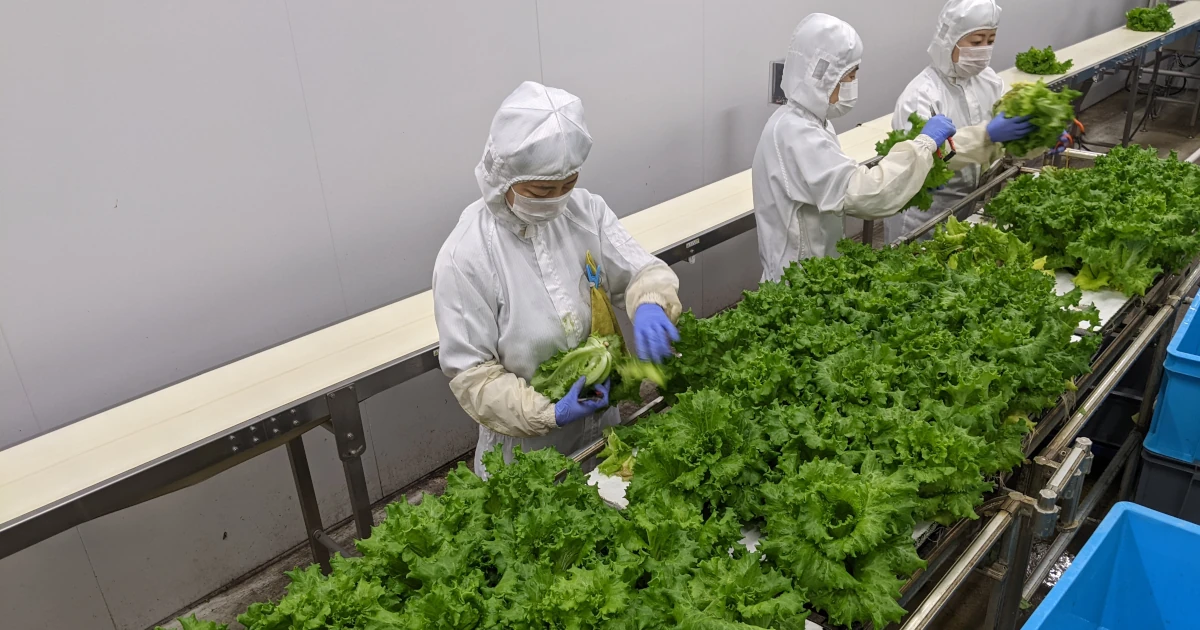
This assessment also meshes with field research. A report investigating Japanese vertical farm vegetables raises the low profitability stemming from their industrial-product character and the supply-demand mismatch as structural problems, and names “securing flexible sales destinations (destinations that can adjust the volume and timing of shipment)” as an effective solution (see 1). Why a commodity contest crumbles easily also shows up in the numbers. The minimum scale that hits lettuce’s break-even point can drop to a few dozen square meters when conditions line up. But a mere 20 percent drop in the lettuce price sends the break-even point leaping to 1,700 square meters, and a 35 percent drop swells it past 100 hectares. A slight move in price shifts the profitability line by an order of magnitude (see 2).
The weakness of power and subsidies lies less in the unit price itself than in the “unpredictability.” Because subsidies in Japan are cut off as one-offs, the foundation of your payback calculation wobbles every year. Going into the black isn’t guaranteed by subsidies either. This is an old story, but a non-peer-reviewed column from 2017 also carried the figure “500 billion yen in cumulative subsidies were poured in, yet 75 percent of the facilities are in the red” (see 4). But this is a single-point number cropping out the industry’s worst period, and the source discloses no method either. Look at the same question in the latest public survey (the FY2025 status survey) and the picture is quite different. Across all operating facilities, 64 percent are in the black or breaking even. But it splits by type: greenhouse and combined types are over 70 percent in the black or breaking even, while PFAL still has about half in the red (see 5). In other words, “even with subsidies, going into the black is not guaranteed” and “subsidies are one-offs and unpredictable” still hold, but the picture of “75 percent of facilities in the red” is no longer the reality. So if you’re going to compete in Japan, you’ll want the order to be: secure first an exit with unit prices that work even at zero subsidy, rather than a plan that counts on subsidies, and if a subsidy comes, treat it as a bonus that moves things up.
Go around the overseas accumulation instead of filling it
As you investigate the strength of overseas hubs, you always snag on the time axis. It’s the matter of “continuity.” The Netherlands has a cheap-gas greenhouse culture, and on top of it, know-how in technology, people, and logistics has piled up over many decades. Singapore too keeps investing with the nation settled in for the long haul. Location conditions have an aspect of becoming accumulation not just by being lined up at some point in time, but by continuing unbroken for decades. The fact that Japan’s subsidies are cut off as one-offs is, in the end, rooted in that same lack of continuity. If so, the person doing this in Japan starts out not only with different conditions, but also without carrying from the start the accumulation that overseas built up over time.

This gap in accumulation is something you go around, not fill. What the Netherlands built up is a whole set - varieties, cultivation recipes, logistics, people - premised on a cheap heat source, and on top of that, it’s accumulation for cheaply running large-scale commodities. Climbing the same mountain again later is impossible, and even if you climb it, you only arrive at a place where the first mover is already at the summit. So you don’t climb the same mountain. The Japan-Netherlands joint research also organizes it this way: the greenhouse environmental-control approach for increasing harvest volume differs between Japan and the Netherlands to begin with, and it’s not a matter of which is superior but that environmental-control technology requires adaptation specific to each country’s and region’s conditions (see 6).
What I meant by “creating it by choosing your buyer” on the sales channel is also an answer to this accumulation problem. The moment you step into the commodity arena, the buyer compares you on the same yardstick as the overseas players with decades of accumulation. But when you go to an exit like “delivering herbs to the spec a specific restaurant chain wants, year-round, in the promised quantity, from nearby,” what you’re competing on is not the accumulation of yield or power efficiency, but the buildup of the relationship with the buyer, of nearness, and of trust. Here you can substitute domestic proximity for the market closeness overseas players enjoy in Europe, and start building it from zero yourself. There are overseas examples that live out this “creating a sales channel by choosing your buyer” too. Middle Eastern reports say a vertical farm between Dubai and Abu Dhabi grows seventy varieties and supplies more than 350 restaurants and hotels (Vertical Farm Daily, 2026). The design of how you win is the reverse of going after the supermarket shelf with commodities.
That said, the lack of continuity in power and subsidies is not something a single company should shoulder. Here, rather, you design so as not to shoulder it. Don’t put recovery on a long-term premise of ten or twenty years. Don’t assemble the equipment as a heavy apparatus that only works with cheap power and long subsidies; hold it with a lightness that can be folded up even if the exit contract is cut, that can be switched to another use. In a Japan with no guarantee of continuity, fold it up from the start into a form where the damage stays shallow even if it doesn’t continue, recoup thin and fast, and factor in that it won’t continue.
That said, this “fold up light” has a flip side that should be set out honestly. A vertical farm is, in truth, a heavy apparatus that can’t easily be folded up - the power-receiving equipment, the HVAC running year-round, the cultivation racks that can’t be repurposed. And the more you aim for short-term recovery, the more the exit sharpens thinly into a single niche sales channel. You set out to take the lightness of being able to fold up, but the moment that single channel is cut, you collapse before finishing recovery - the flip side is that you end up harboring a single point of failure. So while keeping the spirit of “don’t bet on a heavy long-term premise,” don’t bet the sales channel on a single line; run several thin pipes. The fact that the Singapore government is considering a multi-tenant model in which multiple operators share a facility (see 5, Eco-Business, 2026) can also be read, in the end, as wisdom in the same direction: not concentrating weight and risk in a single company.
The difference map is not one-way
The difference map, which lines up the overseas premises and the Japanese premises one by one to see the gap, tends to lean in one direction: overseas is favorable and Japan is disadvantaged. But there are also scenes where the Japanese-side premise works in reverse. For example, in cold regions there’s room to put the outside cold to use for cooling - though this depends on the design of airtightness and heat exchange, and in PFAL the real lead is actually how to vent the waste heat from the lighting. From the feel of the PFAL field I’ve seen, it doesn’t simply go “let outside air straight in and it’s cool”; it collides with managing humidity, CO2, and pest control. Even so, it’s certainly true that the power burden isn’t decided one-way by location. This point can be glimpsed from the research side too: even for the same vertical farm, the environmental load changes by orders of magnitude depending on how that power is generated. The power mix is the main factor that determines indoor agriculture’s environmental performance, and there are even estimates that switching from coal-dominated to wind drops emissions by two orders of magnitude (see 7). The answer to “is the facility good or bad” is gripped not only by facility performance but also by the makeup of the power.
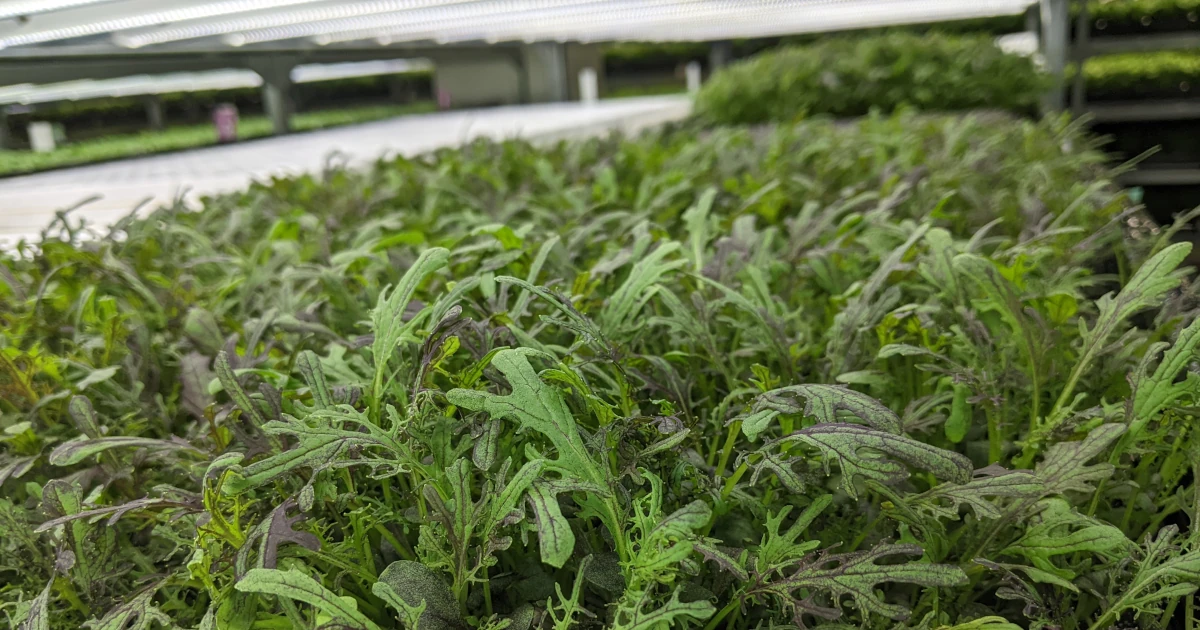
By climate zone, the optimal form of the facility itself also splits. A review targeting certain extreme climates organizes it this way: in hot, humid tropics receiving strong solar radiation and in hot, dry regions, an open structure suits because it vents heat, but pest and disease risk rises; conversely in polar regions and cities with scarce solar radiation, a closed type suits because it traps heat and uses space efficiently (see 8). When the premise of the outside climate changes, the favorable design itself changes. You cannot take an overseas temperate-zone model and use it as a uniform yardstick as-is.
What’s more, the overseas cases we read are all stories of facilities that are still going. The numbers of factories that folded up or operators that withdrew don’t make it into articles. Even in Singapore, where conditions ought to be lined up, the field isn’t necessarily smooth. Right next to that three-percent self-sufficiency rate and “30 by 30,” it’s reported that many vertical farms depend on subsidies and that rising energy prices, rising labor costs, and tough fundraising have produced development delays and withdrawals (Eco-Business, 2026). On the research side too, a case following an actual urban farm reported that the facility could not go into the black on its own and could not compete with commercial urban greenhouses (see 9). Next to the glamorous success stories is this reality that doesn’t easily become numbers. The very picture of “overseas is going well” contains a rosy bias that looks only at the side that survived.
Here, I also want to consider the danger of conveniently gathering up Japan’s advantages. In comparison with overseas, it’s often said that Japan’s water is clean and cheap and its power supply is stable. These are indeed advantages. But they are not the clincher that creates the exit; they are the preconditions that make the exit work. A clinching condition is one that, on its own, makes the buyer say “that’s why I buy from you.” Proximity and fixed-quantity contracts are close to that. But cheap water and the rarity of blackouts are not a reason the buyer says “that’s why I buy.” Hardly anyone will say “the tap water is clean, so I’ll choose this factory’s lettuce.” On the other hand, if the water quality is bad or blackouts are frequent, the very promise of the exit - year-round consistent quality, the promised quantity - collapses. In other words, this is a condition on the side of the foundation that lets you keep the sales pitch, not the sales pitch itself.
So gathering them up is itself correct. But write them not in the column of reasons for the exit, but in the column of cost and risk. Clean, cheap water lowers variable costs, and the absence of blackouts lowers the insurance premium on a fold-up-light design. The room for cooling from the cold goes in the same column. There is one exception. When you choose an exit where that precondition itself is part of the buyer’s selection criteria - a medical or nursing-care meal that frets over water safety, or a buyer carrying a supply responsibility where blackouts are not permitted - “we make it in a country with no blackouts, with clean water” moves, for the first time, to the side of the sales pitch. Whether it’s a supporting role or the lead is decided not by us but by the buyer.
Much of the judgment hangs on who you sell to
In overseas cases, alongside yield and payback years, the points “vertical farm vegetables sell well locally” and “consumers receive them favorably” are also cited as reasons. But this high acceptance, too, can’t be separated from that country’s premises.
Here, I want you to shift the placement once. Acceptance reads closer to reality when you place it not in the column of projected demand, but in the column of “the size of the resistance” per exit. The reason acceptance is high in a country that has few domestic vegetables to begin with is not that indoor vegetables are superior, but that there was no one to compare them with. Japan is the reverse: open-field domestic vegetables are cheap and abundantly available. So at the general-consumer storefront, you should read acceptance on the premise that it’s definitely lower than overseas, and a plan that’s optimistic here is dangerous.
This view is consistent with consumer surveys too. In one market survey conducted in China (n=729), nearly half the respondents (46.6%) answered that they didn’t know vertical farming at all to begin with, and the top concern was high price. The degree of acceptance differed greatly by gender, age, income, and education, and there was also a result that purchase intent rose among segments that weigh cleanliness and freedom from contamination heavily (see 3). This is not a Japanese survey, but the structure carries over as-is. That is, if you take on the “average consumer,” you stumble on price; but if you choose the segment that values that quality, the resistance turns directly into a plus. It’s precisely because you try to measure acceptance by the national average that you misread. Line it up next to open-field vegetables at a general supermarket and the resistance is high. But for fixed-quantity-contract restaurants, medical and nursing-care meals that put hygiene first, and buyers who want the same quality year-round, indoor cultivation becomes, rather, a plus factor. Low acceptance is the story of when you chose a “buyer who could be anyone”; the moment you choose your buyer, that same quality turns from resistance into a positive.
Lining it up this way, much of it connects into one line. Overseas took off not because the facilities were excellent, but because location conditions like cheap power, thick subsidies, and fat sales channels stacked up. Of these, the one Japan can most easily fill is the sales channel - that is, buyer selection. Electricity prices are structurally high, subsidies have unpredictable continuity, and you can’t catch up to the decades of overseas accumulation either. Precisely because there are so many conditions that are hard to move, every other decision hangs on the one thing you can most easily fill: who you sell to.
Turned around, doing this in Japan means neither building the same facility as overseas nor chasing the overseas numbers. It’s finding, one company at a time, buyers who value all of it - Japan’s disadvantageous conditions and its plain advantages like water and stable power - holding it with a lightness shallow in wound even if it doesn’t continue, and, without betting on a single line, running many thin pipes - that kind of plain, case-by-case work. The landing point where you swing toward neither overseas worship nor its flip-side pessimism is right there. That sense of unease, when your hand stopped just as you started to transcribe the numbers - it was, indeed, correct.