Economics and Profitability
Vertical Farm Running Cost: Cut Power, Labor Goes Up
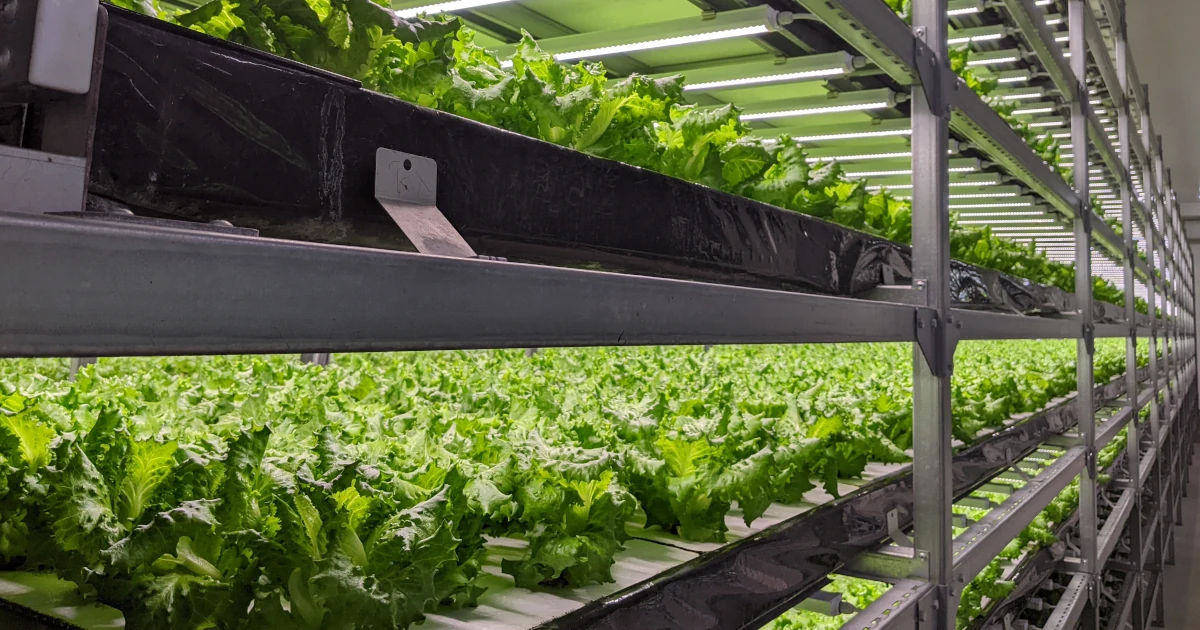
At month’s end, you sit in front of the line-item sheet and think, “Now then, where do I start cutting?” Electricity, labor, materials — run your eye down the lined-up numbers and it usually stops on the largest one, electricity. But these line items do not move independently of one another. Get the order of cutting wrong, and the cost you thought you lowered swells somewhere else.
Cut the heaviest line item and it goes up instead
Thin the lighting by half and that month’s electric bill does indeed drop. But in the normal operating range where light is the limiting factor, yield falls along with it. It takes more effort to make the same amount of shipment, and labor cost per kilogram of shipment goes up instead. The electric bill dropped, yet in total cost per kilogram you have gained nothing. The very act of trying to cut each line item separately is misguided from the start. And this is easiest to see at small sites, where one line item’s movement readily ripples through the whole operation. In a vertical farm, cost ties electricity, labor, and yield together on a single string. Thin the lighting, and the force you applied by pulling the electric-bill end comes out, by way of yield, at the opposite end — labor. Try to cut each item separately on a line-item sheet, and this string stays invisible, so you miss where the force you applied surfaces.
That “electricity is heavy by a wide margin” is not just a matter of feel. In one estimate, a study that did a life-cycle analysis of a PFAL vertical farm reported that the electricity for lighting and HVAC accounts for more than half of the major burdens — greenhouse-gas emissions, acidification, eutrophication — and that for resource and water depletion, very nearly all of it (over 98%) traces back to electricity (see 1). This is the breakdown seen in terms of environmental burden, and it does not map straight onto the line-item breakdown in yen, but that the energy concentrates in lighting and HVAC is clear in itself. That is exactly why you are tempted to think, “Cut the heaviest item, electricity, first.” But that electricity is tied by the string to the denominator, yield. Precisely because it is the heavy item, it cannot be cut on its own.
Telling apart the line items tied to yield
So the order of cost cutting reverses. First you anticipate “if I move this, where does it rebound to, by way of yield” — the force you applied coming back, by way of yield, to another line item — and then you move on the items where that rebound does not come back. Lighting and planting density connect directly to yield, so they sit on the main body of the string and rebound almost for certain. On the other hand, things like HVAC control logic, the sequencing of transport and packing, standby power and how you contract for demand, the procedures for cleaning and record-keeping — these can be cut on their own, exactly to the extent that no string to yield is attached. Even with the same “cost cutting,” whether you pull the main body of the string or snip an end with no string attached, the meaning is entirely different. In this article I keep to what surrounds electricity, labor, and yield, where the linkage is strongest. The same “string” thinking applies to materials, water, and selling costs too, but I start here, where the effect is largest.

What is easy to get confused about here is HVAC. Thin the lighting and the heat it gives off drops, so the cooling load drops by that much too, and the HVAC bill moves in step. Is this an intermediate line item half-attached to the main body of the string, or is it an end that can be cut on its own? It is best to think of HVAC as a line item that branches off partway along the string. It hangs from the lighting by way of heat, so thinning the lighting drops the cooling load in step. But that linkage does not go by way of yield. This is the crux of how to divide things. The linkage running from lighting to heat to cooling is settled by physics, and it moves without touching yield. So HVAC itself can be counted as an end where the rebound does not come back. When you pull the lighting as the main body, HVAC attaches to the negative rebound — that is, to the bonus side that drops along with it of its own accord. Its sign is the reverse of an end like labor, which swells in the opposite direction.
In practice, you fold the HVAC linkage into the netting-out from the start, the moment you move the lighting. On top of that, the HVAC control logic — the range of the setpoint, how hard you run the dehumidifier, the sequencing of airflow — is half off the string of lighting and yield, so you can set it up as a separate end. This one, though, is not completely independent. Widen the temperature range too far or throttle the dehumidifier too tight, and there is a boundary where it rebounds onto yield through disease or leaf-margin scorch. In the range I have seen — sites growing leafy greens under PFAL — the downside swing here is a notch riskier than the upside swing in temperature. Leafy greens packed in at high density develop gray mold the moment humidity is trapped, and if transpiration is insufficient the leaf tips scorch (tipburn). Once such symptoms appear, the number of shippable plants drops sharply all at once, and the electric bill you cut comes nowhere near covering it. So even with the same HVAC, you split it in two — “the part that comes along through heat linkage” and “the part you can move by control” — and then handle the latter while watching yield, proceeding even more cautiously than with the temperature range.
In fact, looking at that weight of electricity from another angle too, these two — lighting and HVAC — account for most of the energy use. One domestic life-cycle analysis (a conference report) reported that, of the carbon-dioxide emissions from a full PFAL, lighting and HVAC make up about 90%, and even in a hybrid type that also uses sunlight, about 70% (see 2). This is the ratio seen in terms of carbon dioxide and is a separate thing from the line-item breakdown, but the size of the physical connection — HVAC hanging off lighting through heat — matches the feel on the ground.
Not in order of weight, but in order of what does not rebound
That electricity is heavy by a wide margin is a fact, so it is natural for your eye to go there. But once you start from “it’s heavy, so cut it first,” your hand usually reaches for the main body — lighting and planting density. The heaviest line item is at the same time the main body of the string, where the rebound is largest. So rather than “in order of weight,” the first thing is to reorder by “what does not rebound,” starting from HVAC control, transport sequencing, and how you contract for demand. It is better to accept squarely that the ranking by weight and the ranking by what can be cut safely are two different things.

As a dividing line: the range that only needs reshuffling of settings or procedures — the temperature range, the airflow and dehumidification logic, the sequencing, reviewing the contract type — can be moved by operations. On the other hand, the high-rebound cuts — lowering consumption while keeping yield without thinning the lighting, reducing the absolute amount of labor — are out of operations’ reach and become a matter of equipment.
One thing to watch, though: automation is not magic that brings labor cost to zero. The labor cost you reduced merely transfers to other line items — the depreciation and maintenance of that machine — and does not vanish along with its string. So you will misjudge less if you see capital investment not as “labor cost disappears” but as “redirecting where the rebound lands, onto a line item that is easier for you to control.”
When it comes to lowering electricity without touching the lighting itself, this is out of reach of changing settings and becomes a matter of the equipment side. For example, there is a report — from a single prototype rack — that an energy-saving cultivation rack, devised with reflective material and how it takes in and exhausts air, held electricity to roughly half the conventional level while keeping the environmental distribution inside the rack uniform (see 3). The aim of the equipment is that the smaller the environmental unevenness inside the rack, the less growth varies, but either way it is a rebuild of the rack itself, so it is squarely a move on the capital-investment side, not operations. It is plainly a different layer from what you can move with settings starting today.
Three line items you can move starting this month
When you actually start today, this month, first review how you contract for power and demand. Pull the most recent meter reading or the 30-minute demand record, and look at a week’s worth of the time bands where the peak stands up. There are cases where the lighting turn-on and the HVAC start-up overlap and push the peak up, so just by staggering the lighting on-time by several to a dozen-odd minutes per piece of equipment, there is room for the peak to drop without touching yield. You can try this today with zero capital investment. But while reviewing the contracted power has a lasting effect once you do it, it is not a move you can repeat every month to pile up more savings.
The second is the range of the HVAC setpoint. You often see settings pinned tight to a narrow temperature band, keeping the HVAC running. It tends to come from anxiety about the room temperature drifting out of range, but just by widening the upper and lower limits by 1°C each and creating time within that range where the HVAC stops on its own, room opens up to reduce running without touching yield. Stop the dehumidifier from running continuously too, and narrow it to only the time bands where condensation or humidity is a concern. But this is the flip side of the disease and tipburn risk from before, so be more cautious than with the temperature range. At sites packing leafy greens in at high density, both lowering and raising humidity too much affect yield, so watch the humidity log and keep it to moving the range just a touch at first and seeing what happens. In a season where the outside temperature moves between day and night, look as well for whether there are time bands where airflow alone is enough. Do not move things big all at once; first, one step at a time — that is safe.
The third is standby power and work sequencing. It is plain, but it is the work of picking up the line items where you are paying money during the time things are stopped. Cut the standby of auxiliary equipment in unused sections and of transport and packing lines not running at night. Switch aisle lights and office-area lighting not directly involved in cultivation to motion sensors or timers. Review the sequencing of harvest and bagging, batch up the same tasks, and reduce the very number of times equipment starts up and stops. None of these readily rebounds onto yield.
The HVAC settings, though, rebound onto yield if you press too hard. So how you verify is crucial. Before you touch anything, be sure to take a week’s worth of baseline. Record the daily total kilowatt-hours, the 30-minute demand peak value, the room-temperature and humidity logs, and yield and the marketable rate. Move only one line item at a time, and watch the difference in the electricity numbers by peak value and kilowatt-hours for about two weeks. The effect on yield, though, has to be followed longer than that. Until the lot planted after you changed the setting is harvested — for PFAL leafy greens, until it goes once around a roughly month-long growth cycle for lettuce — wait and see, then confirm that it has not fallen. Do not jump to a conclusion looking only at the electricity numbers. Move several at once and you lose track of what worked. The order is one at a time, starting from what you are confident does not rebound.
In the direction of “making it work without touching yield,” there are experiments and simulations showing that arranging the physical layout of the lighting — the distance between the light source and the plants, the uniformity of how the fixtures are laid out — can reduce the unevenness of the light reaching the plants at the same electricity. It is an example where reviewing the fixture arrangement evened out the unevenness of the light reaching the plants by about 15% in simulation (see 4). Not everything here is a matter of just fiddling with settings, so this is a move placed between operations and equipment, but that the “make it work without increasing electricity” direction really exists is something you can see from this kind of research too.
Measure the boundary per kilogram of shipment
Take an end to be non-rebounding and cut one line item too far, and the whole can get worse instead. Each individual item has improved, yet the total is worse than before. To measure the boundary, the key is to align the denominator not to “the kilowatt-hours or labor-hours put in” but to “the total cost per kilogram actually shipped.” When the marketable rate falls, all the electricity and all the labor used to make that one kilogram get re-divided over only the amount you could ship. So the moment downstream effort increases, even if the kilowatt-hours themselves have dropped, the per-kilogram figure rises. A reversal invisible in the individual line items only becomes visible once you align the denominator to the harvest amount.
In lighting, by the same logic, another opportunity goes untapped. Lighting has a saturation point: up to a certain light intensity, the more you add the more yield rises, but beyond that, even strengthening it tops yield out and only eats electricity. There is a report that, growing lettuce and basil in a closed type, yield tops out once you raise the light intensity to a certain level, and strengthening it beyond that does not increase it (see 5). The light intensity at which yield per unit of electricity put in (power efficiency) is best differs by crop, and it sometimes nearly coincides with the point where yield tops out, and sometimes shifts a little toward the weaker-light side. Either way, there is a ceiling: push up to the saturation point and efficiency does not improve and yield tops out too (see 5). This is where it counts as an operations-side move. If your current operation is in this saturation range, there is room to lower the lighting output without dropping yield at all — dimming can be not just “a matter of equipment” but a move in operations to get back the electricity that was saturated. Still, whether your own site is really in the saturation range is not something you verify by lowering it abruptly. The direction to press is fixed: lower the total cost per kilogram of shipment within the range where yield has not yet fallen, and stop one step before yield starts to break down. One line item at a time, only after confirming that yield has not fallen — that procedure is exactly for probing the edge of this safe range while you can still walk it back. Not whether the kilowatt-hours dropped, but whether the per-kilogram figure dropped. Make that your axis of judgment.
Here let me add one realistic ceiling. Even if dimming or peak-shifting of the kind we just saw gets back the waste, the part you can move by operations stays a tiny slice when seen against the whole cost. What truly decides the order of magnitude of profitability is a matter of a different yardstick — scale, sales channel, how you choose the crop — and that lies outside this article. Whether your current loss can even be fixed by cutting line items, or whether it is a problem of the cost structure itself further upstream, is better thought through separately once. The right way to frame it: operational moves do not change that structure — they keep waste from leaking out within it and widen your room for judgment a little. Setpoints can be put back, but the yield you dropped or the quality you broke in the meantime does not come back — that is what “while you can still walk it back” means.
Finally, let me write down one dividing line. Everything up to here has been moves kept to “the range you can move by operations” — how you contract for demand, HVAC control, work sequencing, standby power, and dimming and evening-out within a range that does not break yield. These you can touch starting this month without capital investment, and they can be walked back. On the other hand, the high-rebound cuts — replacing the lighting to lower consumption while keeping yield, reducing the absolute amount of labor — are not a matter that stops short of operations; they are capital-investment decisions that transfer to depreciation and maintenance. That is a domain to think about on a different yardstick, paired not with a single year’s electric bill but with the payback period. So the conclusion is plain. Running cost is not a problem of cutting the heaviest line item one at a time; it is a linked system tied together by the same denominator — per kilogram of shipment — so you move one thing at a time, starting from the end that does not rebound, within a range you can walk back — it begins from rebuilding your view into that.
If you would like to do that rebuilding properly, once, on your own line-item sheet, I have prepared a template where you can write out profitability and an operating plan line item by line item (here). Set today’s meter reading and your yield log alongside it, and start from sorting the line items that rebound from those that do not, and the order of cutting comes into view.