Economics and Profitability
Solo Vertical Farms: Paying for Sun and Rain, Scale Hurts

With the capital you have, on this plot of land, on your own. Could you start a vertical farm by yourself? When people think this through, most of them reason in a straight line: “if farming works as a solo trade, then a vertical farm should too.” But that straight-line instinct comes apart at the single most important point. Where it comes apart, and where the surviving path lies regardless, I will trace from the structure of the economics.
A vertical farm buys the sun and the rain back with electricity
Can you make it as a solo vertical farmer? When you weigh that, anyone who has an open-field grower nearby probably pictures a scene like this. There is an old man who has worked his field alone for decades. He honestly does not look like he is making much, yet he keeps going. Even in the year a typhoon wiped out everything, the next year he is growing again. So you feel that “if farming works as a solo trade, a vertical farm must too.”
But look closely and there is just one reason that old man could keep going for decades, weathering bad-harvest years along the way. The sun, the rain, the land — none of them are things he pays someone every month to rent. If the land is his own, it was already there from the start. So in a bad-harvest year, even as the harvest nears zero, the money going out shrinks to match. Reduce the planting and you travel that much lighter. Even in the worst year he can choose to “not run it,” and stopping stops the bleeding. When income falls, spending falls with it — it is a structure that stretches and shrinks. Once you see that open-field farming at least works this way, the sight of that old man lasting for decades makes sense.
Now picture the vertical farm side, and it does not go the same way. The electricity cannot be switched off. The loan on the equipment will not wait. As long as it is running, money goes out. That sense is not a trick of the mind — it touches the very core of the question of whether a vertical farm can be done solo.
A vertical farm, and especially a PFAL that produces even the light with electricity, is buying back wholesale the infrastructure that farming got to use for free. Lighting instead of the sun, a circulating nutrient solution instead of the rain, a building and HVAC instead of the land. What was free has been swapped out for a monthly electricity bill and an equipment loan. And so that “stretch and shrink” from before disappears. Whether or not it sells, the electricity bill and the loan repayment go out at a near-constant rate. Income can fall all the way to zero, but spending will not fall to zero. That gap is exactly what that feeling — of the minus advancing even while you are stopped — really is.
This swap shows up quite clearly in the research too. Measured as electricity per kilogram of harvest, open-field farming is roughly 0.3 kWh/kg. Indoor multi-layer cultivation is around 250 kWh/kg, two or three orders of magnitude apart (Reference: 1, 2). The whole cost of buying the “once-free sun” back with electricity is loaded right there.
And that electricity bill is far from a bit player in the operation. In a calculation for growing wheat indoors, more than half of the operating cost is taken up by electricity for lighting (Reference: 1, 2). Looked at through greenhouse gases and resource depletion, the electricity for lighting and HVAC alone accounts for more than half of the impact, and over 98% on the resource side (Reference: 3). Averaged across PFALs, electricity is roughly 20% to 40% of production cost, and most of that goes to lighting (Reference: 4). “Cannot stop” is not a metaphor. It is a structural fact: a large share of the money going out is concentrated in two systems — lighting and HVAC — that kill the crop the moment you switch them off.
So this is not a question of solo versus corporate, nor one of grit or technique. The way I see it, the arena itself is different. Farming is a contest you survive by “enduring.” PFAL is a contest where you “cannot stop.” Even the same “can you do it on your own” carries a different question inside.
On the arena of cutting cost through scale, the solo operator is the most disadvantaged
The stretch-and-shrink disappears; this is a contest where you cannot stop. Suppose that framing has landed. Here one snag comes up. If the free infrastructure is being bought back with electricity and fixed costs, then surely someone doing it efficiently could bring that cost down. Buy electricity in bulk at a large vertical farm, line up plenty of equipment. Think it through and you get this view: isn’t this a world where the bigger the scale, the cheaper each unit becomes?
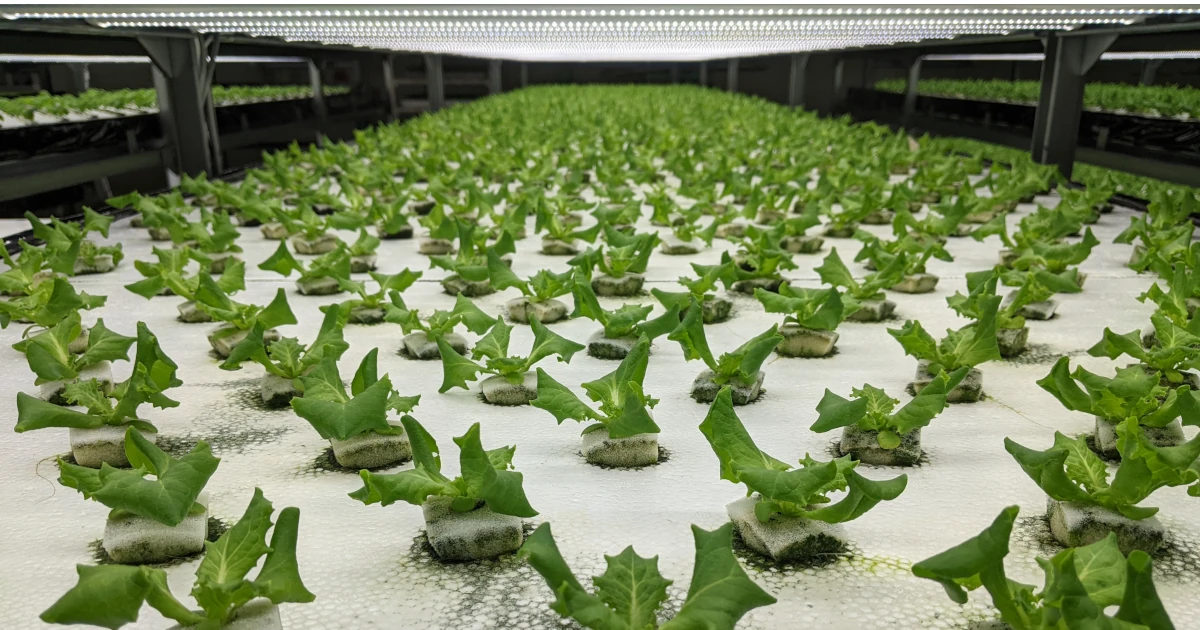
That view is correct. It is a point you should not fudge. “The bigger the scale, the cheaper each unit” bites quite strongly in PFAL. The unit price of buying electricity, the unit price of equipment, the labor cost per person — all thin out as scale grows. And they do not just thin out. Because it is a contest where you cannot stop, the big, well-resourced players are on the side that can endure and wait out a year or so of losses. The fixed costs do not thin out, and as long as they do not fall, the smaller the operation and the thinner its cash on hand, the shorter the time it can endure losses. Being unable to thin out the costs and having less time to hold the line stack up in the same direction.
This sense is backed up by the numbers too. A calculation that gathered 26 Japanese PFAL facilities to study construction cost found an elasticity where a 100-fold increase in scale lowers the per-unit construction cost by roughly 55% (Reference: 5). On the fixed cost of building, bigger really does bite.
But there is one thing I want to say carefully. This scale effect was confirmed only for the “cost of building.” For operating costs such as the monthly electricity bill or cooling bill, the same study sets the assumption that “no economies of scale are expected on operating costs.” In other words, “it does not bite on operations” is not a finding clearly shown by the data — it is how the calculation was set up (Reference: 5). Bigger does build cheaper. That is certain, but you cannot go so far as to say that even the heaviest cost in a contest where you cannot stop — the electricity bill — thins out with scale. That is a part where it is better to leave room for nuance.
That being so, as long as you look at it on the same arena of the race to produce cheaply, on the single axis of scale the solo operator stands on the most disadvantaged side. This is not a gap you can paper over with “but if I get clever about it.” It is better to begin by admitting you are at the bottom of the most disadvantaged slope, structurally. What I do not want misread is this: it is a matter of slope, not of the floor giving way. Being small does not mean black ink is impossible. But when a shock in price or contract comes, you are on the side it hits first and deepest. The gap that farming had — “scraping by, small but steady” — is hard to find on this axis. That much is the truth.
But here I want to stop just once. Everything I just called disadvantaged was on the same arena of “how cheaply can you produce each unit.” That the solo operator cannot enter the race to produce cheaply is, by now, beyond changing. If so, there is only one path left to the solo operator. It points to where the arena itself is different — to whether somewhere out there is a buyer who is not measured by cheapness. Though, to be honest, finding that buyer is itself not easy.
What you can win at is not cheapness but delivering close by without ever running short
There is no winning the race to produce cheaply. Suppose that has landed — then where is a “buyer not measured by cheapness”? When you try to picture it, what comes to mind right away is probably something like the neighborhood farm stand. The open-field old man, too, is not going head to head with the supermarket; he keeps going because part of his crop sells as “the vegetables from over there” within the circle where faces are known.

But the moment you try to do that with a vertical farm, it suddenly gets hard. Open-field vegetables carry on “from that field over there.” But does lettuce grown by electricity in a factory get the same “from over there”? If anything, some people seem to tense up a little when they hear “made in a factory.” That hesitation is valid. Even the “buyer where faces are known” that should be the refuge once you step off the cheapness arena — the vertical farm cannot enter it as smoothly as farming.
The reason the open-field old man’s “from that field over there” works is that consumers feel value directly in the story that it was made with soil and sun. But PFAL is on the very side that bought that story back with electricity. In the research too, consumer acceptance itself is listed as one of the barriers to adoption (Reference: 6), and the people who tense up at “made in a factory” are probably not imagining it. We are not even standing on the arena where “from that field over there” can win. Trying to compete head-on with a consumer-facing brand means choosing, all over again, the same arena where farming is weak. So that, I think, is a poor line to take.
But the instant you think of the buyer as a “consumer where faces are known,” the path narrows to a single line. That is not it. What I want to shift to is one step further out. Not cheapness, not story — there should be buyers who pay money for the very thing of “arriving from close by, at a steady quality, without ever running short.” A local restaurant, say. A prepared-foods maker turning out deli dishes and salads. Places like that, more than the question of taste, are troubled by getting the same thing, in the same quantity, with the same face, every week — that is my read. Open field sways with the weather. Sourcing from far away gets eaten away by freshness and shelf life. The very traits of PFAL that I have been calling weaknesses up to now — “cannot stop,” “not swayed by the outside” — here, conversely, have room to be priced in as a form of stable supply.
And to that kind of buyer you can deliver not the cheap lettuce anyone can grow, but high-unit-price leafy greens that travel poorly. Fine herbs, things that bruise easily and cannot be shipped from far away. You can deliver them precisely because the distance is short. The direction is to lean toward items that simply do not set foot on the arena of cutting cost through scale.
Why do you have no choice but to lean toward high-unit-price leafy greens? This too is visible in the research. The largest recurring cost in PFAL (the closed type) is the energy for lighting and HVAC, and several papers point in the same direction: this cost structure itself binds crop choice toward crops that earn enough margin, or it does not pay off. In fact, for the time being the crops that can be expected to turn a profit in the closed type are limited to leafy vegetables, herbs, basil, and the like. The shared read is that staple grains — the kind that supply about 60% of the world’s food energy — cannot be made economically viable at scale with today’s technology (Reference: 7, 8, 9). So “lean toward high-unit-price leafy greens” is less a strategy of preference than something the cost structure has already narrowed down in advance.
But I do not want to wrap this up as “so the buyer will be found.” If anything, the opposite. Before you build, lock down with that restaurant or prepared-foods maker a fixed promise of “I will buy exactly this much every week.” That is the only narrow path the solo operator can stand on in PFAL — but securing that promise before planting is itself probably the hardest thing in this whole discussion. What waits once you step off the race to produce cheaply is not an easy buyer. It is another hard place, set even further out.
Fixing demand before you build is the single hardest place
Let me push a little further into that “other hard place.” Before you build, secure fixed customers. Even if you manage that, the real test starts here. And the difficulty does not end with the question of whether to narrow your buyers to one line or spread them across several.

First, the more your sales lean on a single line, the more everything on your side is decided by the other party’s circumstances alone. That is an easy fear to grasp. So spread it across several, you think. If you can diversify, the fragility of a single line does indeed ease. But that “state of having secured enough buyers” is a view you see only after crossing the lean-income period before the business gets running — the valley, so to speak. A solo operator with zero track record securing, before planting, not one but several fixed contracts. That is harder still than securing one. So rather than “it is frightening because it is a single point of failure,” the truth, I think, is that whether or not you diversify, fixing demand before you build is itself the first and hardest hurdle.
And there is one more thing you notice. Even before the danger of betting on one line, isn’t the time when you are out trying to secure that promise the most fragile of all? Once the promise is in hand, at least something comes in. But in the period when you have not yet secured even one, the equipment is already running and electricity and repayment are going out, while what comes in is zero. And the other party has to enter, before planting, into a promise of “I will buy exactly this much every week” with a solo operator who has no track record yet. From their side, you must look like someone who has delivered nothing so far. So the longer the securing takes, the more the bleeding alone advances. Before the danger of betting on one line, the time you are out courting that promise is when the money is thinnest and there is the least room behind you. You are made to cross the deepest part of the valley while holding nothing yet. The stable buyers that a running operator holds are the view after crossing this valley, not the view mid-crossing.
Compare with the open-field old man here, and what is left underneath you, before and after crossing the valley, is clearly different. The old man, even if his buyer cuts him off in the worst case, can fold up small: “all right, this year I’ll just grow what I eat myself.” Because he has the field, and the sun is free. Cut back, and what goes out falls with it. The stretch-and-shrink from before bites once more here. At least for open field, that makes sense. But with PFAL, the moment you are cut off, what is left is not a field but the electricity bill and the repayment. Try to fold up, and the moment you stop you can no longer grow anything, yet the fixed costs keep going out. I said stopping production stops the bleeding, but the equipment loan and minimum upkeep do not fall completely to zero even when you stop. What is left underneath — on one side it is a refuge, on the other it is a weight.
When a buyer’s price moves, it bites all at once. Just how much it bites is something one calculation lays out concretely for lettuce. Assuming advanced technology and a revenue-cost structure, the minimum planting area at which lettuce breaks even is roughly from about 38 m2 (this is an accounting break-even, not a scale that means it covers labor or living expenses). But let the selling price fall just 20% from there, and that break-even scale leaps all at once to 1,700 m2. Let it fall 35%, and it already exceeds 100 hectares (Reference: 5). With the price moving only slightly, the viable scale shifts by two or three orders of magnitude. The fear that “the buyer’s circumstances alone decide everything” is backed by this high price sensitivity. I should add that this is a value from a model calculation for the single crop lettuce, so it is not a figure that applies directly to other crops.
And this is not a matter of “big capital is fine.” A survey of large-scale Japanese protected cultivation and vertical farms (a population that also includes greenhouses, differing from the solo PFAL in both type and scale) reports figures where, depending on the survey, 49 to 75% are in the red. Even on the side that has piled up technology and capital, roughly half can end up in the red. The heaviness of the initial and operating costs is repeatedly pointed to as a structural challenge as well (Reference: 10, 11, 12). Even the well-resourced side has scenes where the household books do not add up — and within that same structure, where does the smallest-scale solo operator stand? That is what the words “most disadvantaged slope” really contain.
So I do not think this is a problem that solves cleanly. Step off the race to produce cheaply, and fix down a buyer who pays for stable supply. I said that is the narrow path left to the solo operator — but that path takes the shape of betting, at the bottom of the most disadvantaged slope, in the most fragile period, on the promise that hurts most if it falls through. As for whether it can be done, this is a gamble. And it is a gamble that bets on the hardest spot among the gambles you can choose. That, I want to set down honestly.
Work back to scale from the buyer, not from the capital
Hearing all this, some will take it as “so the solo operator can’t do it” — but that, too, is probably not accurate. It is true you are on the most disadvantaged slope, and it is not something I can promise will make a living. But it is also not “absolutely impossible.” I will not say it cannot be done, nor that you can pull it off. Both would be lies in this setting.
What I do want to leave with the person standing in that precarious spot is this: turn the order of how you decide scale upside down, just once.
Ordinarily people think: I have this much on hand, I can get this much land, so I can probably run at about this scale. They go to set scale from capital and land. But what bites most in a contest where you cannot stop is how many fixed buyers you have pinned down before you build. So reverse the order. Rather than deriving scale from capital, work back to your own viable scale from how many promises of “I will take exactly this much every week” you have secured up front. If the promise is small, the equipment can be small. If the promise is zero, that scale is zero.
So I will also set down clearly the line you do not cross. Building equipment with not a single prospect of a fixed customer is crossing the valley empty-handed in the lean-income period. Better not to. And if your sales depend on a farm stand, with both the price and the take-up volume swaying at the mercy of the weather, then the more you scale, the more that sway becomes the size of the wound. The more you scale, the deeper. So: buyer first. Until you have it, do not build. I say this not as encouragement but from the structure of the bleeding.
This line connects straight to the price-sensitivity point from before. In a world where the viable scale changes by orders of magnitude with the selling price moving just 20%, loading large equipment on top of a wavering buyer means taking on that full swing directly (Reference: 5). So “buyer first, do not build until you have it” is, rather than a matter of mindset, a thoroughly practical conclusion worked back from a cost structure this sensitive to price.
And then, bearing in mind that this is a contest where you cannot stop, one last thing. This is not something to hold inflated hopes about. But are your own resources — time, money, stamina — properly gathered at the hardest spot, namely fixing down the buyer? Are you, caught up in clever ways to produce cheaply or in building out equipment like full automation, taking your eyes off the one point that hurts most if it falls through? Whether you can keep checking that for yourself, before you build and after. If there is a form that lasts even while small, it is probably only there. I am sorry it is not a clean conclusion, but what I can say honestly ends here.