Farm Operations Management
Plant Factory Hygiene Management: Cleaning Hits a Floor
Articles for Farm Operations Managers
When you keep raising the cleaning frequency and the numbers will not move, usually the only thing you can see is “wipe more.” But is the real problem the frequency? Somewhere in your procedure, the first assumption — that hygiene is “the job of washing” — may have been buttoned up wrong from the start.
Why the total viable count floors out even as you raise the cleaning frequency
“We went from three times a week to every day, and the total viable count in the clean room is no different from before.” You thicken the manual, add more places to wipe, and still it floors out at the same number — have you not had this experience?
Let me note one thing first. Foreign-object complaints (hair, insects, packaging fragments, and the like) arise mainly from the workers, the raw materials, or the packaging process, and I do not deal with them here. What this article takes up is the “microbe side” — the story of the total viable count and root-zone diseases flooring out.
As long as you think of hygiene management only as the volume of work, “how much do you wash,” you will probably not climb out of this floor. Let me put down my view first. Microbes cannot be brought to zero. However much you isolate the building, there is always the small amount that comes mixed into the tap water or the nutrient solution, and once temperature and water line up, they are always somewhere. So I do not see much point in pinning down where they came in from. There are two problems. Are you making a place where those microbes multiply (a breeding ground)? And are you spreading contamination that has become concentrated in one place into a place that is supposed to be clean? Unless you hold those down with the structure of zones and flow, a problem that sits on the structure side will not disappear with how often you wash. That said, even if I lead with the structure story, the walls of the facility you have now cannot be moved right away. So in this article I proceed in this order: first hit it with washing and drying, which you can start today without spending money, and then read what still will not come down as a sign of structure. What hitting erases, operation erases. What dutifully returns to the same spot even when you hit it becomes proof that structure is at work. That is the way to read it.
A note: what the rest of this builds on is mainly what happens in hydroponics. Read it as me applying that to the field of fully-artificial-light leafy greens. This is also the range in which I have worked with my own hands in the field, so when I write further on that “I have seen it many times in the field,” take it as the story of PFAL leafy greens.
Walk the floor and you notice something odd. The bench you wipe every day is reasonably clean, while the underside of a rarely touched shelf or the joint in a pipe — places not in the cleaning procedure — have worse microbial numbers. The places you wash and the places where microbes multiply are simply out of alignment. Rather than too little cleaning, I see this as microbes settling in where condensation and organic matter pool and never dry. Leafy greens run on water. Inevitably, leftover water and nutrient solution pool in low spots, joints, and around the drains. Those spots suit microbes in both temperature and humidity. Thicken the manual and add more places to wipe, and if the breeding ground for multiplication itself is on the structure side, it floors out — I have seen this many times in the field. So the first thing I look at is not the cleaning sheet but “where does water stop and not dry.” If the design dries, it never becomes a contest of how often you wash in the first place.
What is more, in hydroponics it has been reported that the very fact that the nutrient solution circulates through the facility can become a structure that gives organisms able to move through water, such as Pythium, a boost to multiply. (see 1) But this is easy to misread: circulation itself is not the evil. The same paper also lays out that gentle treatment such as slow filtration (a biofilter) can actually suppress microbes in the circulation system. (see 1) As long as you secure enough flow, keep it from stagnating, and run it normally, the risk does not spike because of circulation — that is my read. What becomes a problem are the spots where the flow stops and water stagnates, the spots that never dry. At least in nutrient solution systems, whether microbes multiply easily comes down — before the matter of how often you wash — largely to the structure side: whether water stagnates, or whether it flows properly.
The structure of flow that keeps concentrated contamination out of the clean zone
If the place where they multiply is on the structure side, the next thing that matters is where you let those microbes become concentrated and where you let them spread. The microbes themselves are everywhere, thinly, a little. The problem is whether a route remains inside the facility along which microbes that should be thin become concentrated in one place and are then carried into the growing area, which is supposed to be clean.

Take seedlings. The medium and the root zone are originally a place with more microbes, a concentrated place. Bring it into the growing area as is and you are placing concentrated contamination in a place that is supposed to be clean. However much you wash the room, the microbes clinging to the seedling will not drop with cleaning frequency. The other one is the flow of people and things. Through propagation, transplanting, harvest, and packaging, carts and people pass back and forth and cut across rooms that are supposed to differ in cleanliness. Cart wheels, boots, and gloves carry the concentrated microbes from the dirty side straight to the clean side — that is how I see it. So the point to hold down is the structure of fixing the place where you receive seedlings to a single point and building the flow as a one-way path from higher cleanliness to lower. Do not let it run backward, do not let it return. Do not bring the microbes from the concentrated spots into the thin ones. Hold that down in the design and the washing afterward becomes much easier.
When you put the flow in order, dividing the facility once into three by cleanliness makes it easier to see where things cross. When I inspect the flow in the field, I largely look at the drawings by this same division.
| Zone | Cleanliness | Specific places | Required measure |
|---|---|---|---|
| contaminated zone | Low | Facility entrance, office, restroom, break room | Stop contamination brought in from outside |
| transition zone | Medium | Material prep room, changing area, hand-washing area | Do not move contamination into the clean zone |
| clean zone | High | seeding, growing, and harvest areas | Carry out strict hygiene management |
If you inspect your own facility, the things to look at are largely fixed. Whether people and things move properly one-way, from the higher-cleanliness room to the lower. Whether there is any scene where a cart or person runs backward from low to high. Whether the seedling receiving point is fixed to a single spot, or whether they enter from all over. Hold this up against the drawings and the actual movement, and you start to see how far your current flow has erased the carry-in and crossing of concentrated contamination, and where it still leaves it. Just making the boundaries visible with color-coded floors or signs already changes how people move.
This read also fits research that traced how microbes are carried within a hydroponic system. It has been reported that microbes are brought in when seedlings are transplanted, that the nutrient solution itself readily becomes a route carrying microbes through the facility, and that water in particular readily becomes the main carrier. (see 2, 3) Both are movements — microbes carried from concentrated to thin — that however much you wash the room are hard to reach with cleaning frequency. That is exactly why this connects to holding down the way they are carried itself, with the structure of where you receive seedlings and the flow.
How to tell the problem you erase with structure from the one you move with operation
By here, both the place where bacteria multiply and the route by which concentrated contamination spreads have come into view as sitting on the facility’s structure side. So now drawing the line becomes the issue. Is it “a problem that will not disappear unless you fix the structure,” or “a problem you can reach by changing how you wash and disinfect” — how do you tell, in your own facility.
What works here is the order I wrote at the start: “first hit it.” Change the frequency or the places of washing and drying, and if the numbers come down readily, it was a problem operation can reach. Conversely, if the same south-side line recurs only in the rainy season even after you double the cleaning — if it returns dutifully at a particular place and a particular season — I see that as a sign on the structure side. It comes out at the same spot however much you hit it. That floor is exactly what tells you the breeding ground is on the structure side. That is the way to read it. Another clue is whether it comes out the same way at the same spot even when you change the person in charge. If it changes when the person changes, it is the worker side; if it comes out at the same spot whoever does it, it is the structure side — that is the split. You cannot be certain, but it is a read formed from watching how the numbers come out for a while. Whether it moves readily, or stubbornly returns to the same spot — that is the biggest dividing line.
When you read this “repetition,” there is something to keep in mind. When microbes show up in a test, it is usually after something has already happened. For microbes in the hydroponic nutrient solution, it has been reported that molecular-level detection methods have been developed that can catch them quickly and with high sensitivity. (see 4) Turn that around and it is better to keep in mind that even where the test numbers show nothing, microbes may still be surviving where there is a breeding ground. So rather than one test coming back negative, I weigh “whether it returns to the same spot every time” after you hit it, more heavily, as a sign on the structure side.
Operational moves for when you cannot fix the structure right away
Even once you find that the cause is on the facility’s structure side (the flow, the partitions between rooms, the zoning), redrawing or rebuilding that in the facility you have is not so simple, and it costs money. It comes close to a rebuild. The structure itself cannot be touched right away — standing on that premise, is there an operational move you can make work as “a substitute for structure”? Let me go through them in order.
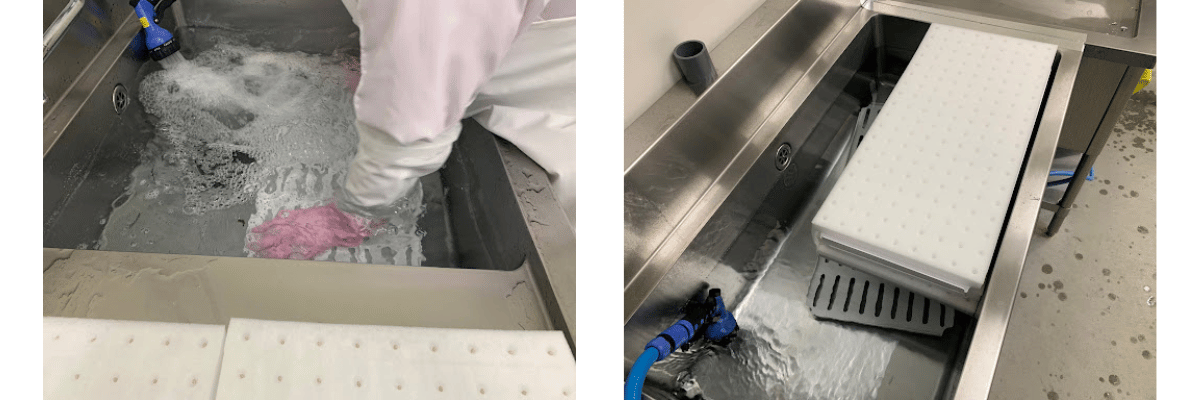
First, fix the place where you bring in seedlings to a single point, and split the carts between the high-cleanliness and low-cleanliness sides so they do not mix. Even without a physical wall, that holds down the carry-in and crossing of concentrated contamination. Next is the way of dividing by time. Group the clean work in the morning and the dirty work in the afternoon, making the one-way path with time. It is a way of zoning with “order and time” in place of a partition. But unless you insert cleaning and drying after the afternoon dirty work to reset, that dirtiness carries over into the next morning’s clean work and the one-way path collapses. Once you divide, always reset once — the two go together.
Then, the water side. Even if you cannot fix the slope or the drainage right away, just draining and drying the water left in pipes and tanks that go unused after the workday, the pooling in low spots, and the drainage routes makes what stagnates and multiplies much weaker. What you drain here is not the circulating nutrient solution itself during cultivation (the nutrient solution running continuously with plants in place is an asset, not something to drain every day). It is purely the point of not leaving water that has pooled unused after the workday and does not dry.
Turn to the structure itself and take, for example, the floor. Putting in a slope of about 1/100 so water does not pool keeps water from lingering in low spots. This is a structure-side move that works at new construction or renovation. Even if you cannot redraw it right away, knowing “where in the current floor water remains” decides where to dry intensively after the workday.
That said, what these operational substitutes can erase is only the bringing-in and crossing of concentrated contamination. The parts you cannot fully separate by time or order — like condensation inside the same room or a breeding ground in the piping — remain. It is safer to keep in mind that those come back, in the end, to drying design and the structure side.
On top of that, disinfection (ozone, UV, chlorine treatment of the nutrient solution) is also a move, but it is something you layer on top of having cut, to some degree with structure, the route by which bacteria spread and the breeding ground; putting it in is not the end. There are conditions to how disinfection works that fit the literature’s account well. Disinfection against hydroponic pathogens has meaning only as a preventive measure before an outbreak; treatment after disease has set in is said to be hard to make work. (see 1) Also, chlorine-based, chlorine-dioxide, and UV disinfection can indeed lower bacteria, but how well they work changes greatly with the type of pathogen and with the disinfectant’s concentration and exposure time, and there is said to be no cure-all method that works on everything with one. (see 6) Ozone can likewise lower bacteria, but its effect depends on concentration and how it is applied. (see 5, 7)
If you use a disinfectant, observing each product’s concentration and contact time is the premise. For sodium hypochlorite, for example, 100–200 ppm as available chlorine with a contact time of 5 minutes or more is one rule of thumb (a widely used operational guideline in the industry; in the field you adjust from there to suit the conditions).
There are side effects too. There are reports that ozone treatment lowers the iron and manganese concentrations in the nutrient solution, or that it reduces not only the targeted pathogens but the beneficial microbes along with them. (see 1, 7) So treatment comes in this order: an operation you layer on top of having cut with structure. Rather than leaning entirely on disinfection equipment, keep it from stagnating, run it normally, wash and dry — and on top of that, layer only as much disinfection as you need.
A hygiene investment judgment that does not lean entirely on certification and test numbers
The view up to here — “separate what you can erase from what you move” — becomes, as is, the story of how you allocate money. Hygiene management does not become the goal at the point you obtain a certification, nor at the point a test came back negative.
As a handle on cost allocation, start by dividing places by level of risk and changing the cleaning frequency accordingly. Washing every place at the same frequency is an inefficient use of limited time. When I think about how to allocate time in the field, I largely organize it in these three tiers.
| Risk | Frequency guideline | Main targets |
|---|---|---|
| High risk | Check daily | nutrient reservoir and circulation system, harvest tools and containers, areas handling seed and seedlings, post-harvest processing area |
| Medium risk | 2 to 3 times a week | Growing-area aisles, frequently touched control panels, ventilation filters, material storage area |
| Low risk | About once a week | Office, break room, exterior passages |
Spend time on the high-risk spots and streamline the low-risk ones. This division is the foundation of a hygiene management you can keep up. But this is purely the allocation of “how often you hit.” When a spot comes up that will not come down however much you hit it, see it as a problem of structure rather than frequency, and shift where you spend money to the structure side. The frequency table and the structure judgment are used together, as one continuous footing.
HACCP and audits, too, I think of less as “the goal” and more as “a framework that gives you an order to think in.” Obtaining them is not the end; rather, they are the starting point. If you have not cut, with structure, the places where bacteria multiply and the routes by which they spread, then even holding a certification, the microbial numbers will not drop any further. Test numbers, the microbial counts that come back from culturing, are also something I think it is better not to over-trust at a single point. Even if treatment makes them stop coming up in culture on the surface, whether you can flatly say they are truly gone is unclear. So rather than one number, I look at it by how it comes out — where it keeps coming back. Investment judgment is the same: spend money first to crush the structure side that returns to the same spot again and again, and arrange the operation side, which moves only as much as you touch it, afterward. Separate what you can erase from what you move — only from there is the allocation of cost decided.
There is backing for this caution about test numbers, too. There are reports that even in a non-sterile nutrient solution, bacteria involved in food poisoning such as Salmonella and Listeria survive as they are for a certain period. (see 8) You cannot flatly say “it is safe now” for the sole reason that you manage the environment or that you disinfected. So a stance of looking at how it comes out itself, rather than leaning on one test number, is what works.
Hygiene does not end at the point you obtain a certification, nor at the point a test came back negative. First hit the count with washing and drying, then read the floor that still remains as a sign of structure. Cut the structure — the places where microbes multiply and the routes by which concentrated contamination spreads — separate what you can erase from what you can only move, and keep watching where it keeps coming back. That patient stance is exactly what works, in the end.