Industry Trends
Vertical Farm Sustainability: Less Water, 10x Open-Field Power

2026-06-11
Is hydroponics genuinely good for the environment, or is it a power-hungry nuisance? In investor briefings, in buyer selection, in internal approval requests alike, vertical farms tend to be talked about in this binary. And on either side of the conflicting claims, the meeting moves along without anyone able to land a decisive counterargument. Does that ring a bell? The problem isn’t being for or against. It’s the failure to draw the boundary line of “under which conditions it wins, and under which conditions it loses.”
Water savings didn’t drop; they just moved to electricity
People often say hydroponics “doesn’t use much water.” It’s true that the water is recirculated, so at the farm’s own tap, it does save water. But the electricity to run all that lighting and HVAC is generated somewhere, at a power plant, using water. The farm can save water, yet that water has merely moved over to the electricity side. It just dropped out of sight; it didn’t disappear. And this pattern of “merely moved somewhere” is not confined to this one case.
The “water savings” of recirculating hydroponics is a fact. But it’s also a story that narrows the field of view to just upstream of the tap. If the lighting and HVAC are powered by fossil or nuclear generation, water is needed to cool the power plant. So rather than “it uses no water,” the accurate view is “the water use moved from the farm to the power plant”: it’s hidden, not gone. That said, this isn’t to say “since it merely moved, water-saving operation is pointless.” Reducing water bills, wastewater treatment, and fertilizer loss upstream of the tap is itself a real benefit to the operation’s wallet. In what I’ve seen on the floor at PFALs, handling wastewater and fertilizer was one of the spots where it pays off. It does matter; it’s just that the water hasn’t vanished from the planet as a whole. The same structure shows up elsewhere. “No pesticides” works because, instead of letting insects in, you keep the indoor environment clean with HVAC and filtration, maintained by electricity. And “no soil” just means you make the nutrient-solution fertilizer in a factory and truck it in. Each of these is merely shifting one burden to another place, another resource. Before deciding good or bad in a word, why not first doubt: “did this actually drop, or did it just move somewhere?” And depending on whether what it moved to is electricity or water, and on what is cheap and what is expensive in that region, the win and the loss swap places.
This view that “what dropped on the floor has moved to another column” shows up clearly in the numbers, too. Closed hydroponics brings irrigation water down to around 1% compared with open-field lettuce in California or Arizona (see 1). There are also reports that for leafy greens, depending on the crop, water can be cut by up to 99% (see 3). It is certainly a column where you win big. But this water win only carries large value in regions like California or Arizona where water is precious and expensive. In regions where water is plentiful and cheap, the same “99% savings” comes out small in monetary terms, and the win thins out. And the same study also shows the primary energy used to cut that water. Open-field lettuce is 10.7 megajoules per kg, whereas indoor (closed) hydroponic lettuce is 162 megajoules. More than ten times. In greenhouse-gas terms, too, it runs to roughly 8-10 times open-field and greenhouse, and the main driver is said to be electricity (see 1). “Winning big on water and losing big on electricity” happens simultaneously within one and the same sheet. It backs up the view that it didn’t drop, it moved across columns.
For the record, the reason the numbers line up cleanly here is mainly PFAL: closed, LED-grown leafy greens (lettuce). Sunlight-using greenhouse types, and fruit-bearing crops like tomatoes and strawberries, are in a different order of magnitude for both economics and environmental impact, and need to be viewed as a separate table. For what follows, too, please read any figure without a caveat as being about PFAL leafy greens.
The dividing line between winning and losing moves with the power mix
Does the burden at the place you shifted it to actually end up larger than what dropped on the floor? Even after shifting it, maybe it’s break-even overall, or even slightly ahead: that thought creeps in. And if the win and the loss swap by region, perhaps there’s a clean dividing line somewhere, some of you may be thinking.
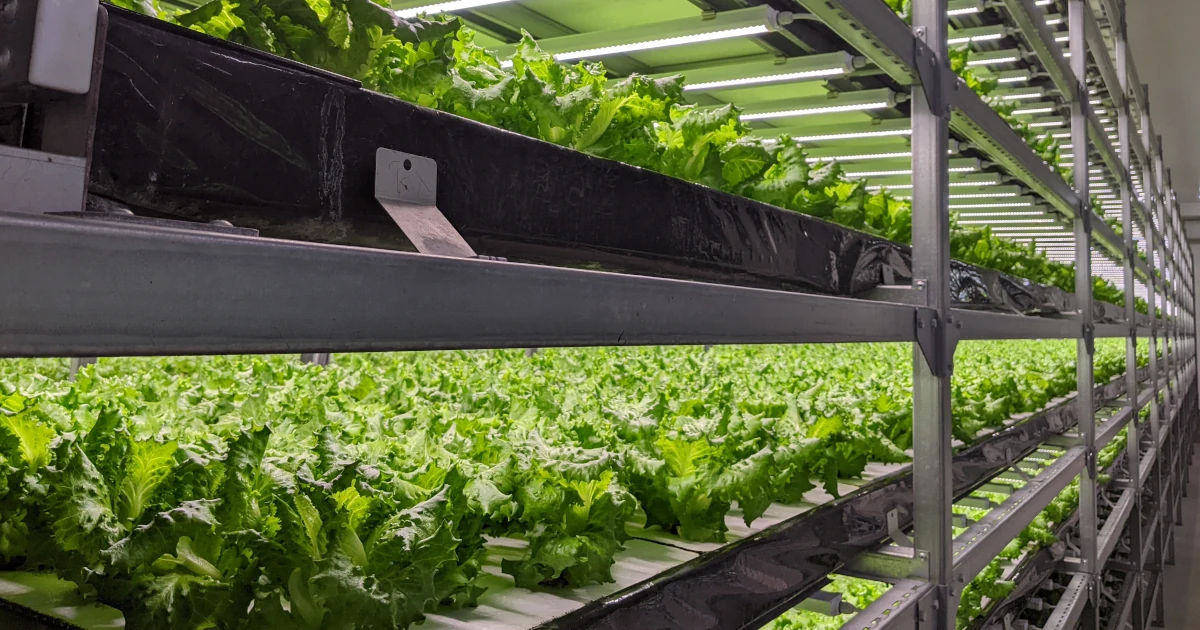
At the very least, shifting it doesn’t always come out ahead. Hydroponics is a good example. The energy for photosynthesis that the sun did for free outdoors is, indoors, taken over entirely by electric lighting. The generation that supplies that electricity also costs water and energy, so the water you cut on the floor doesn’t necessarily turn into a net gain just as it stands. The lighter and lower-priced the crop, like leafy greens, the heavier the electricity burden lands at the place it moved to — that’s how I read it from working through the numbers. So can a single clean dividing line be drawn? Not quite. The deciding factor is “what that electricity is made from.” For the same vertical farm, in a region rich in hydro or solar where the electricity is clean, it tips to a win; in a region centered on fossil power, no matter how much water you save on the floor, it loses on the power-plant side. So the more a region is fossil-centered and high-carbon, the more the dividing line between winning and losing is drawn first at the power mix. Conversely, in regions where the electricity is already clean, the effective move shifts instead toward other refinements. Crop, power source, distance hauled: only when these conditions come together is the win or loss settled.
That “photosynthesis is taken over by electricity” does show up properly in the numbers. Vertical-farm lettuce uses roughly three times the energy of greenhouse cultivation, and about 60% of that is estimated to be lighting (LED) (see 4). That’s why the electricity burden comes out heavier the leafier the crop. And there is backing, too, for the view that “the line is drawn first at the power mix.” For the same vertical-farm lettuce, switching the power source from coal to wind is estimated to bring greenhouse gases to roughly 1/100 in one calculation (see 4). This is a single estimate cited in an opinion piece, so the order of magnitude itself isn’t something to put on a banner, but it does serve as material to show the direction: that it’s the power source you connect to, not the facility’s specs, where the win and loss swap. One life cycle assessment also reports that “urban agriculture is uniformly better/worse than conventional agriculture” cannot be said, and that depending on the combination of crop, cultivation technology, climate, and power source, there was no farm that beat conventional on every indicator (see 5).
Refinements that cut electricity get you both economics and the environment
So far we’ve looked at the environmental win and loss. But the people who run a farm, and the people who fund it, have another yardstick: economics. If you yourself were the one operating such a farm, or the one funding it, how would it look? Does “improving the environmental numbers” look like it pulls against “improving economics”? Or are there parts that move in the same direction? Sustainability tends to be talked about as if it were a separate thing from economics, but what is it actually?

To state the conclusion first: economics and the environmental numbers, far from being separate things, point the same way over a good portion. Start with electricity. At a PFAL vertical farm, the biggest cost is the electricity bill, and the biggest factor in environmental impact is also electricity. So refinements that cut electricity directly translate into lowering the electricity bill. Here they point in almost the same direction. That said, there’s a condition worth watching here. Energy-saving equipment, high-efficiency LEDs and HVAC, swapping out insulation, takes a fair amount of upfront investment. Getting both only holds “when the electricity-bill savings justify that investment and its payback period.” On top of that, in what I’ve seen on the floor with PFAL leafy greens, pushing energy savings too hard comes back at you elsewhere. Throttle the light or HVAC too hard, and with dense planting it gets muggy, the lower leaves get damaged, tipburn and sorting loss increase, and you can lose more on yield than the electricity you cut. So “cut electricity and get both” holds with the caveat: within a range that doesn’t break yield. The distance hauled is the same: produce right next to the consuming area, and transport emissions and transport costs fall at once. Because freshness holds up better, waste loss is also likely to fall: that’s hard to assert outright, but as a direction I see the environmental numbers and economics moving together. Still, not everything points the same way. Choose clean electricity, and renewable power currently often costs more per unit to procure than fossil, so there are cases where the electricity bill actually goes up. Running on cheap fossil is easier on economics, but it loses on the environment. This is the one spot where they pull against each other. So we sort it: “cut electricity” stories shake hands between economics and the environment, while “clean up the power source” stories collide with price. Only the latter pulls against. The former are allies, if anything.
That “electricity is both the biggest cost and the biggest environmental factor” is confirmed from the cost-structure side, too. In an estimate for a facility growing wheat indoors, more than half of operating cost was taken up by electricity for artificial lighting. Assuming current electricity and capital costs and wheat prices, cost ran roughly 46 times revenue — a level that simply doesn’t pencil out (see 7). Put the other way, refinements that shave this electricity shave the single biggest cost item directly. The environmental numbers and economics point the same way precisely because of this structure. So the split that “the cut-electricity bucket gets you both” is rooted not in intuition but in the breakdown of cost.
Measure the location’s credit and the factory’s credit separately
In a region rich in hydro or solar, it tips to a win. Have you ever felt a snag with this? Namely, that this just amounts to “build in a good place and you win,” and is a separate matter from whether the vertical farm itself is good for the environment. The “clean up the electricity” part should benefit anything that uses that region’s electricity, vertical farm or not. Seen that way, the credit specific to a vertical farm comes out as only the “cut electricity” refinements.
In fact, the “clean up the electricity” part is not credit specific to a vertical farm. If that region’s power source is clean, the factory next door, or a household, benefits just the same. The vertical farm happens to be sitting on top of it, and counting that as its own credit isn’t fair. To see a vertical farm’s own net contribution, you first line up the power source as neutral and compare. On the premise of using the same electricity, what can be reduced versus outdoors: how much more efficient you can make the lighting that takes over photosynthesis, how much you can cut transport and waste loss, how you save land and water. This difference, which remains even when you decouple it from the power source, is the credit specific to a vertical farm. Put the other way: “built in a good place” is the location’s credit, “cut electricity” is the factory’s credit. They should be accounted for by separate origin. Mix the two together and say “vertical farms are good for the environment,” and you make the favor of location look like the factory’s own ability. This logic applies just as well to the earlier water win. The cheapness or dearness of water in a water-stressed region is a circumstance of location, not the factory’s own ability.
The point that “what you take as the denominator” reorders the ranking also connects to this separating-the-origin story. This is one instance of the general rule that the way you take the denominator moves the ranking, but: in one urban-agriculture comparison of vegetables grown in unheated greenhouses, measured per cultivated area, carbon emissions were about 15% lower, yet measured per weight of harvest, they came out higher instead — a reversal the study reports (see 2). This isn’t a figure specific to PFAL; it’s an example of a different type (greenhouse, smallholder vs. large-scale home delivery), but the structure itself of “change the denominator and the ranking moves” works regardless of type. Win on area and lose on weight: both are correct numbers for the same subject, yet the conclusion changes with how you take the denominator. So before saying “vertical farms are good for the environment” in a word, unless you attach what denominator and which power source the figure was measured on, you make the favor of location or of measurement method look like ability. As for shortening transport distance, too, its share of the whole supply chain is small, and its reduction effect is pointed out to be easily overestimated (see 5, 6).
Split the columns you report as numbers from the columns you leave qualitative
When you bring talk like this into a setting such as an internal approval request, or an explanation to a buyer or investor, you can’t get away with writing “environmentally friendly” in a single phrase. That said, not everything can be put into numbers, either. There are things you can split into columns and report as numbers, like power, water, and waste, and things you can’t yet reduce to numbers and leave qualitative. Around where should you draw that line so it won’t waver later?
In an approval request or an explanation to investors, first write things clearly split into “what can be reported as numbers in a column” and “what stays qualitative.” The rule of thumb for the line is whether you can fix that region’s power mix and what you take as the denominator, per area or per weight, to one each, and calculate without moving from there. Electricity use, on-site water, transport distance, and waste loss can be reported as numbers once the premises are lined up, so they go in columns. Conversely, the prospect that the power source will become clean down the line, or a sense of reassurance from local production for local consumption, will waver later if you dress it up as a number. Since changing the power mix collapses the whole premise, you put these honestly in the qualitative column. In other words, you sort it: “cut electricity” stories are numbers, “the power source gets cleaner” stories are qualitative. The factory’s own ability can be reported as numbers, but location and the future power source depend on premises, so you place them in the qualitative. Sort it this way, and even if the power premise moves, the factory-side numbers survive, so you avoid “that’s not what you said” later.
The line that “what would waver later if dressed up as a number, you let escape to qualitative” is also reasonable for preventing the accident of overclaiming. For instance, it’s tempting to trumpet urban agriculture as “contributing to resource circulation” in a big way. But when you actually measure the material flow, in one city, it stayed at a mere 0.44% of all the phosphorus that city consumes as food, and using up the city’s waste phosphorus would require 2-4 times the city’s area (depending on how you take the premises), one estimate finds (see 8). Claims of scale can come out small when you actually measure them. That is exactly why columns you can measure with fixed premises, like electricity, water, and waste, you report as numbers, while talk of scale and prospects like “it’ll get clean in the future” or “it’ll change the whole city,” you place honestly into the qualitative column without letting it pose as a number. Do that, and even if the premise moves, the factory-side numbers survive.
To organize it, for a factory growing leafy greens as a PFAL, the win and loss per column line up roughly like this. Use it as a starting draft to refill with your own factory’s numbers.
| Column | Tendency of win/loss | Premise when turning it into numbers |
|---|---|---|
| Water | (In water-stressed regions) wins big | Can be reported by on-site use / in cheap-water regions the win is thin |
| Primary energy / power source | Loses big (the gap widens with the power mix) | Calculate with the power mix fixed |
| Waste / transport | Both, depending on conditions | Can be reported by distance and loss rate |
| Future decarbonization / scale contribution | Don’t turn into numbers | Leave in the qualitative column |
Try to decide “good or bad for the environment” in a word, and the winning columns and the losing columns cancel each other out, leaving you unable to say anything. First doubt whether it dropped or merely moved; separate the location’s credit from the factory’s credit; and split the columns you report as numbers from the columns you leave qualitative. Run these three through, and a word that was only an impression turns into a single table you can verify on the same footing as the other side.