Farm Operations Management
Hydroponic Seeding: Good Germination Still Loses Yield
Articles for Farm Operations Managers
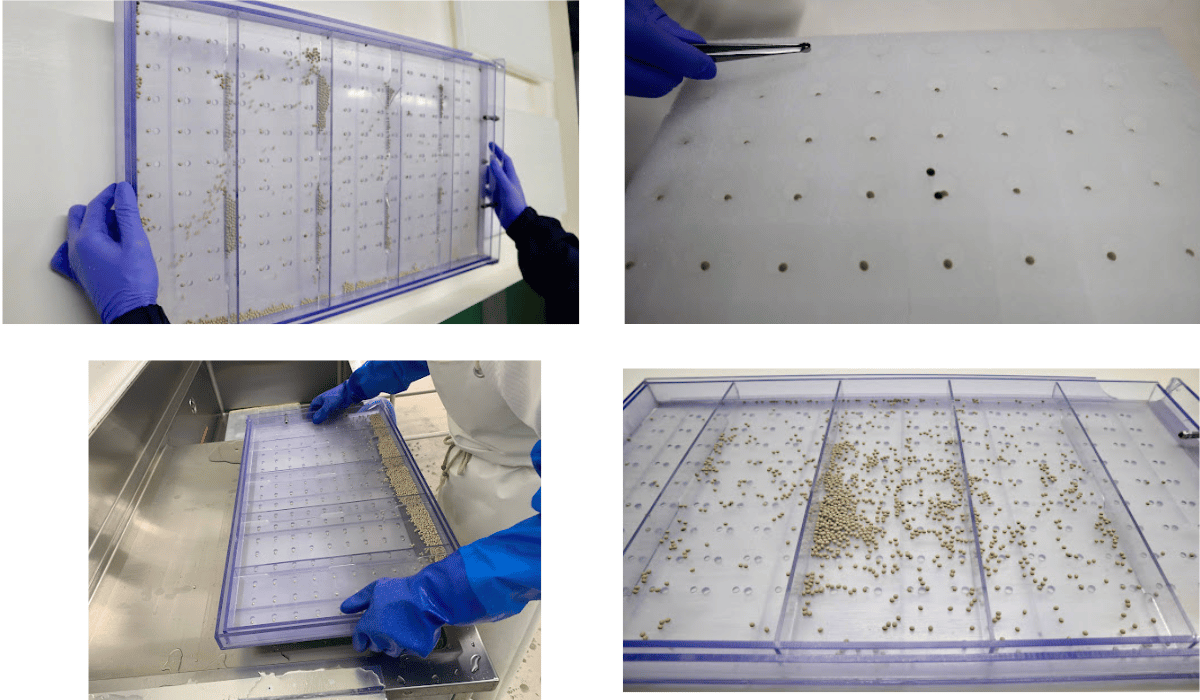
The germination rate only looks at whether a seed put out a sprout or not. Whether they sprouted together, or came up scattered over many days, leaves no trace in that single number. When yield drops in the later stages, looking back over my own runs, more often than not the culprit was uneven emergence.
The “evenness” the germination-rate number does not show
You sow seeds into a tray and wait a few days. Close to 90 percent put out sprouts, and you feel satisfied for a moment: “Oh, this run looks good.” The problem is what comes after. Even at the same 90 percent, there are times when they all come up together, and times when they trickle up over several days, staggered. Looking at the number alone, both are 90 percent. But the tray that didn’t come up together, staggered in time, becomes hard to handle right from around transplanting. Match the pace to the big seedlings and the small ones get left behind; wait for the small ones and the whole batch stretches out and runs late. When I think back on the runs where my yield was mediocre, more often than not I land on “the seedlings weren’t even that time” rather than on a low germination rate. Is this just my imagination? Or, separately from the germination rate, is the “evenness” something I ought to be watching?
Let me give the conclusion first: evenness is worth watching. It is not your imagination. The germination rate is a number that counts only “whether a sprout finally came up,” a tally of the came-up / didn’t-come-up choice. It carries no information about “when” a seed came up. So a tray that all came up at once and a tray that came up in dribs and drabs over three days both line up as the same 90 percent, as long as they reach 90 percent in the end. It is only natural that the numbers look the same. The germination rate throws away the timing — when each seed came up — right from the start. Evenness can be understood as “the spread in the times at which each seed put out its sprout.” If the germination rate is height, evenness is width. At the same height, whether the width is narrow or wide makes everything afterward an entirely different matter.
That earlier “hard to handle from around transplanting” is the heart of it. Sowing and germination look like a process that closes in a few days, but in fact the evenness of the seedlings you made there trails on, through transplanting and growth, all the way to the yield weeks ahead. The germination-rate number comes out in a few days. But the true answer to whether the sowing was good or bad comes out later, with a delay. Germination is not the goal; it is the entrance to a long process that continues all the way to harvest. So watching evenness separately from the germination rate is less about adding one more indicator, and closer to pushing the moment you judge whether the sowing was good or bad later — from right after germination out to the yield in the later stages.
Rate is height, evenness is width, and the true answer appears later, with a delay. There is an observation close to this view. In a study that applied supplemental LED lighting in forced strawberry culture, even when light was added in the same way, whether yield ultimately rose was split by the flower-bud characteristics of each variety, and in one variety yield did not increase (see 1). This is about strawberries grown for fruit (a fruit vegetable), and it does not carry over directly to the sowing of leafy greens, but the point connects: whether the treatment at the entrance was good, and whether the result climbed in the later stage, appear separately. With lettuce under artificial light, there is also an observation that the total amount of light accumulated from the early period correlates with the weight of the plant at harvest, which meshes with the view that conditions arranged at the entrance take time to act on the amount of growth in the later stage (see 2).
Let me be honest about one thing. There are still not many studies that have followed the evenness of germination itself all the way to harvest. Please treat what I say here as a working hypothesis, pieced together from what is known about the neighboring processes of transplanting and growth.
Evenness starts to become visible at the entrance, in the width of “when they came up”
You look at a seedling box after the sprouts have all come up and reflect: this time they were even, that time they were scattered. I think it is a common scene. But that may only be looking at the spread at the point where germination has “finished.” That way you don’t know until you’ve come right up to transplanting, and even if you think there might have been something you could have done at sowing, it’s already too late. Where, then, does this evenness start to become visible? Is it already split at the stage when the first sprouts begin to come up in dribs and drabs, or does it look the same partway through and then a difference open up later? And is that spread the individual variation of the seed itself, or something you can still move with how you even things out after sowing?
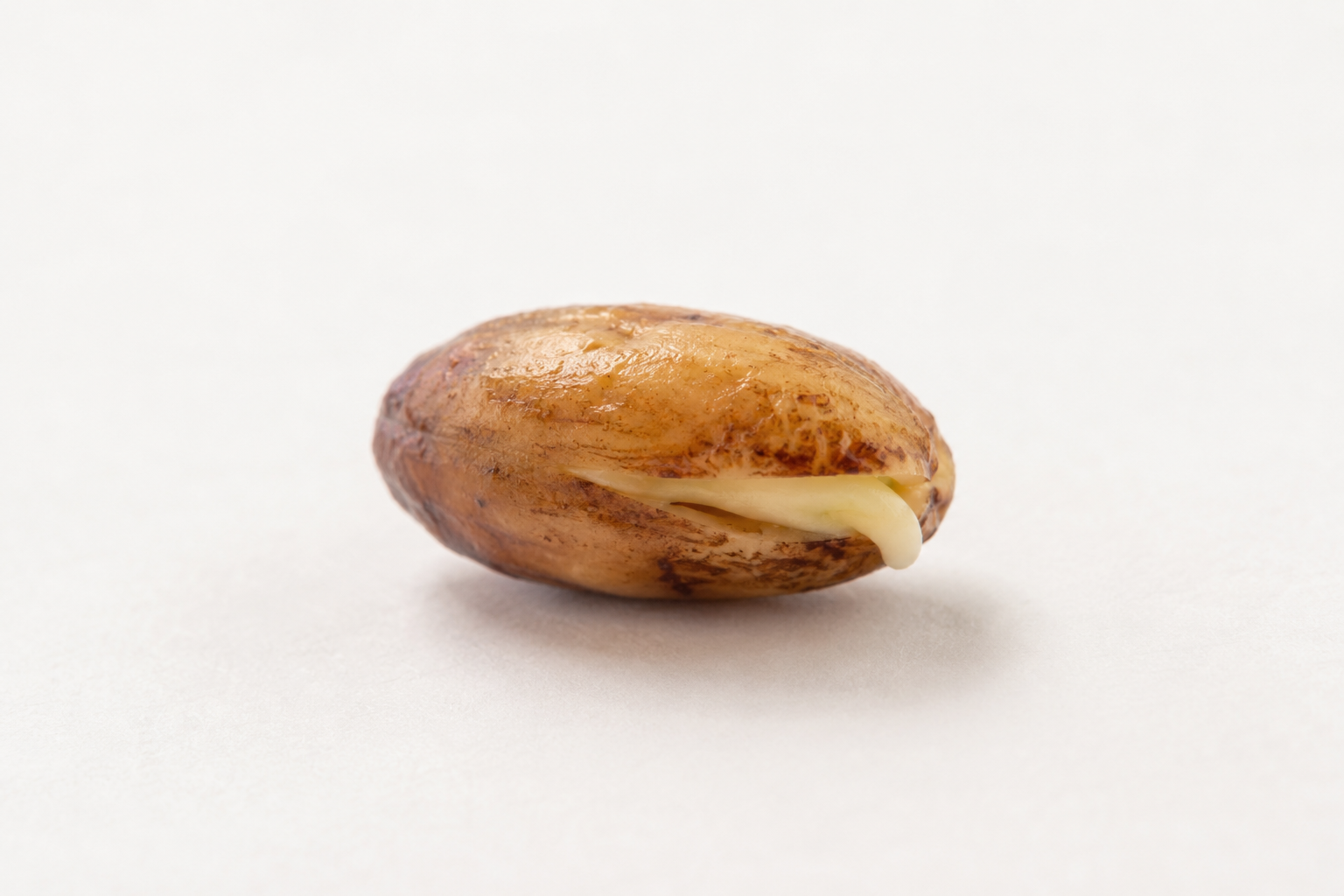
When you think about what evenness really is, the timing you should watch moves from the end of germination toward the beginning. Because evenness is the spread in “when they came up,” what first comes up is not the point when the last ones have all come up, but the entrance where the earliest sprouts begin to emerge. Even at the same 90 percent, there are runs that fit tightly within a half-day width and come up all at once, and runs that keep coming out from the first seed, dragging on for two or three days. Whether the first dribs and drabs are a “lead group” or “just a false start” is decided by how closely the rest follow behind. So rather than looking at the number that comes up at the start, look at the “time they took to come up” — from when they begin to come up until most are up. That becomes visible long before germination finishes, far ahead of transplanting. A run with a slow start has a long interval before the first sprout comes up. In other words, the very stage of “the sprouts haven’t all come up yet / the emergence is late” is already a sign of a difference. If you notice it early there, you can still move it.
Here, let me set a footing in the physiology of the seed. Germination proceeds roughly in three stages. First the imbibition phase, where the seed takes up water and swells; next the metabolic activation phase, where the enzymes that had lain dormant inside the seed begin to work and break down the stored nutrients; and then the radicle-emergence phase, where the root breaks through the seed coat and comes out (the shoot follows). Laying them out in this order makes it visible why, within the same tray, some seeds have their germination switch flipped and some do not. For each individual seed — how much water it could take up, whether the temperature was riding in the band where metabolism moves, whether oxygen was sufficient — the difference in how evenly those were met comes out as the difference in when they emerge. The spread in evenness appears all at once at the end, but in terms of physiology it has already begun to split from the imbibition stage.
Is it individual variation, or room on our side? Both. And, what’s more, they can be separated. The individual variation of the seed itself certainly exists, and it sets the “lower bound” of evenness. No matter how well you even out the conditions, they will not come up more evenly than the seed’s own spread. But from what I have seen in PFAL propagation, the runs that scatter are often ones where the environment hasn’t been tightened all the way down to that lower bound. Unevenness in temperature and moisture after sowing — at the edge versus the center of the tray, on the upper versus the lower shelf, the environment the seeds sit in is not even. On my own sites, it often happened that when they came up shifted depending on the shelf position. Within the same tray, some seeds are in conditions where the germination switch flips, and some are not yet. That comes out as a difference in timing. So the order is: first, try to kill the environmental unevenness completely. The spread that still remains after that is the seed’s own lower bound. Only when you have gone that far can you say this is individual variation.
The environmental unevenness itself is certainly there in actual measurements too. In a study that analyzed the interior of a vertical farm used for propagation, temperature and air velocity differed with the position of the cultivation shelf, and humidity varied by as much as 23.8 percent from spot to spot (see 4). Read this not as a measurement of the size of temperature unevenness itself (the temperature difference between shelf positions came out small in this study), but as circumstantial evidence that, even within the same facility, temperature, humidity, and airflow are not even depending on where the seeds are placed. That when they come up shifts because of temperature unevenness is, when it comes down to it, a hunch I have formed by guesswork on site. In fact, even the lettuce seedling study cited here (see 2) reports that within the PFAL, air temperature and humidity were largely even, and what worked was cumulative light and planting density. So casting temperature unevenness as the sole culprit goes too far; the honest position is to see temperature, moisture, and seeding unevenness each as having an effect.
Even so, it is certain that there is room to move in how you even things out after sowing. For example, with buckwheat, there is a report that a pre-treatment of letting the seed take up water before seeding (a few hours to about a day at 20–25°C) improved the uniformity of germination and the speed of standing up (see 3). Buckwheat is a different crop from leafy greens, so how it works doesn’t carry over as is, but it is the soundest single example that evenness can be moved depending on the sowing method and pre-treatment.
A scattered evenness cannot be evened out again in the later stages
So, can the spread in evenness be recovered in a later process? There are things that can be recovered and things that cannot. Here you can draw a clear line. Adjusting fertilization and light in a later process to bring quality together — that certainly happens. But that is about lifting or arranging the “level,” such as the size and quality of seedlings that came up evenly, and it is a different matter from evening out scattered seedlings again along the time axis.
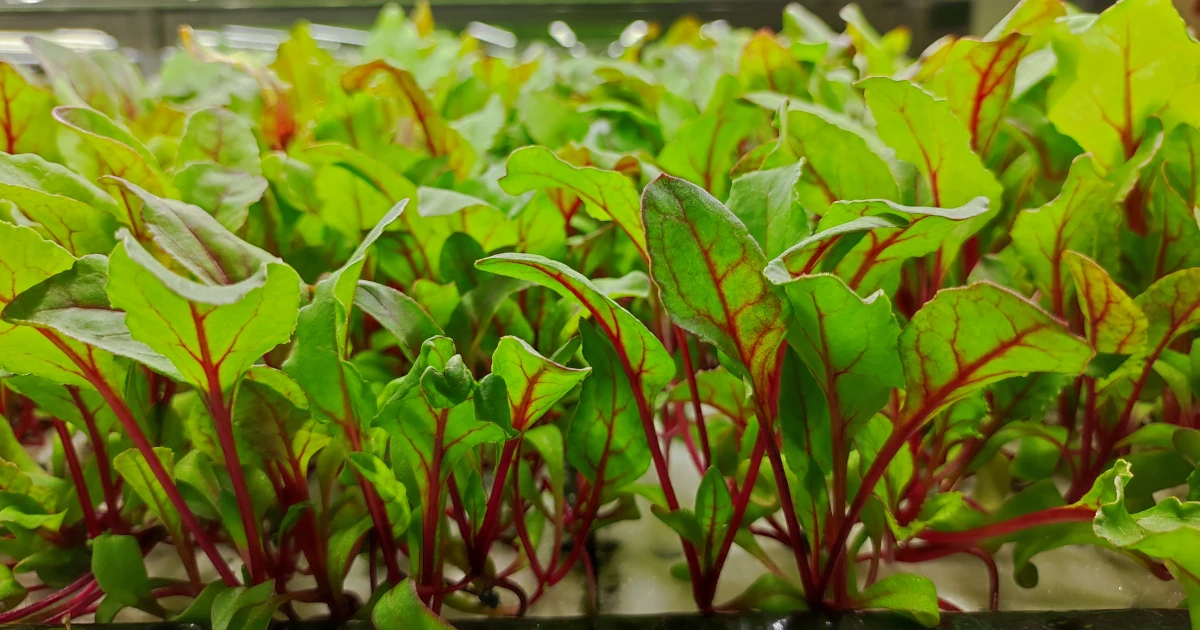
Why can’t the timing spread be evened out again? Because evenness is not a “difference” in size but a “difference in timing.” A seedling whose germination was half a day late is not merely small; in terms of development it is half a day behind. It is younger than the seedlings that went ahead. Of course, depending on the light and nutrient conditions, there are situations where the size difference between individuals narrows somewhat. But that is a matter of “level,” and the temporal gap of when each came up cannot itself be narrowed. Add fertilizer or light at the back end and the whole batch just advances by that much; the gap between the front and the tail end keeps moving along, still open. Once the timing spread in germination has set in, you cannot wind it back, time and all, in the later stages.
Does that mean the later stages are powerless? No. Pulling an even group out of a scattered batch is, in itself, something done routinely on indoor farms. Looking at the seedlings and sorting them — grading; image-based sorting; taking a wide harvest window to absorb the spread — these are not patched-up cover-ups but standard processes on site. What they have in common, though, is that they are not erasing the timing spread itself. Thin out the lagging individuals and even the batch up to the front, and those seedlings get thrown away. Widen the harvest window, and the shipment and the turnover of the cultivation shelves develop a spread. In other words, the runs that look like re-leveling are usually absorbing the timing spread by paying a cost in yield or labor; the spread itself has not vanished into nothing.
So, when it comes to evenness, it is better to hold it not as “I can fix it later” but as “absorbing it later costs something.” A timing spread that has once scattered cannot be evened out again in the later stages as if for free, and it is largely decided at the entrance. What can be left to the later stages is arranging the level on the premise that things are even, and recovering the loss of a scattered run as small as possible through sorting or the harvest window. Watch when they emerge at the entrance, and kill the environmental unevenness right there. Treat evenness as something you make there, and do not expect “re-leveling” for free from the later stages. This matters.
There is also an observation that a state made at the seedling stage affects things later. In a study that optimized light quality in three stages of lettuce, matched to each stage of growth, the optimized plot had a harvest weight 21 percent higher at that point than the lowest-performing plot, which used white LED alone (see 5). How far the effect of crafting the light quality remains in the end is limited even within the paper, but it is one example showing that the groundwork laid at the entrance stage can affect the endpoint reached in the later stages.
Record the emergence window at two points and guess from temperature
Whether germination comes up even or scattered shows in the emergence window. So, concretely, how should you record that width? Two points of notes are enough. Observing the whole tray in detail is impossible, so look once a day at a set time, and note two points: “the day the first sprout came up” and “the day they roughly all came up.” Even that much works as an emergence window. The emergence window is, in short, how many days it took from the first seed coming up until most were up, so as long as you can take the difference between the two points, that is the width itself. That once a day at a set time will do is also a key point. By looking at the same time, you can compare one sowing run against another with the same measuring stick. Evening out the conditions every time works far better than raising the precision of the observation.
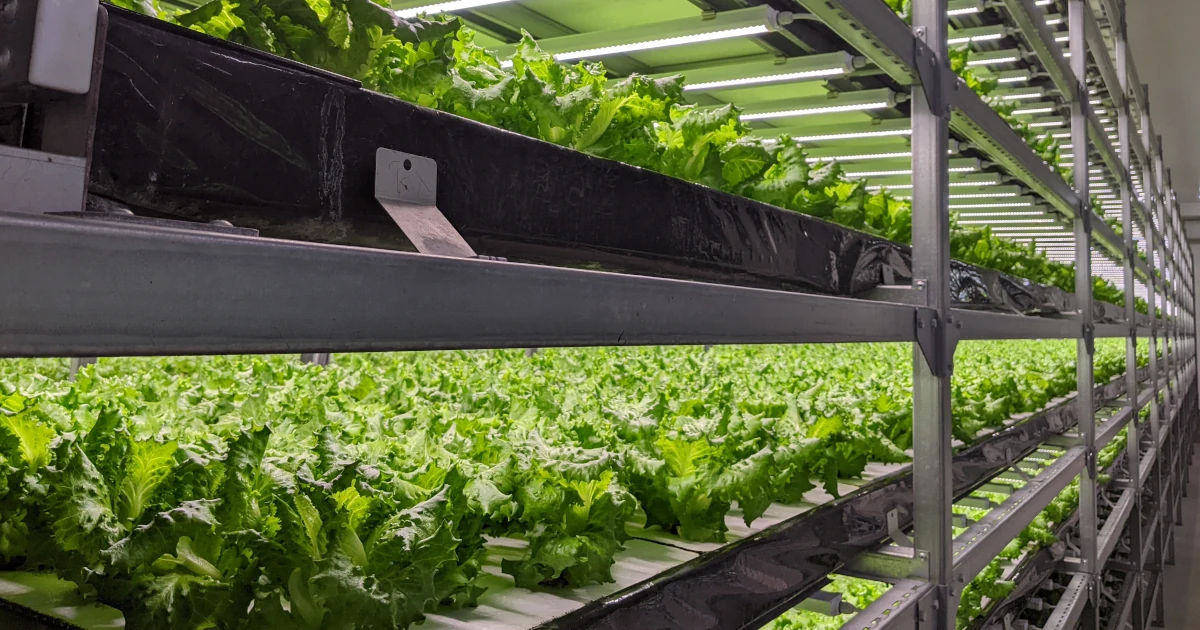
Let me add just one thing. For “the day they roughly all came up,” I recommend taking it not as the day 90 percent came up but as “the day about 80 percent came up.” The last 10 percent gets pulled around by the seeds that come up late or never come up at all, so the date blurs easily. Cut it at 80 percent, and when the main body of that run finished standing up comes out plainly. This 80 percent line is not just a number for record-keeping. On the propagation floor, the practice is to remove the humidity-retaining cover (the dome) placed right after seeding once roughly 80 percent have germinated. Remove the cover too late, and with no light reaching them the seedlings grow lanky and stretched, and the excess humidity makes disease more likely too. In other words, the cue for the operation “remove the cover at 80 percent” and the cue for the observation “record the all-came-up day at 80 percent” overlap right at the same 80 percent point. Jot down the date while you are removing the cover, and you do the job and the record-keeping in one go. The day of the first sprout, and the 80 percent day. Just line up the difference between these two points run by run, and the even runs and the scattered runs start to come apart quite clearly. Detailed observation is enough afterward, once a run you’re concerned about turns up.
Up to here has been about how to record. As for the environmental unevenness that is the cause of the spread, I recommend starting with temperature first. When the spread in the seed lot or the medium itself is large, that is a different story, but if you want to take a quick guess at hand, start with temperature. Here, keeping in mind the temperature band you are aiming for makes your hands move more easily. The optimal temperature for germination differs by crop, and from the feel of the leafy greens I have grown, there was at least this much of a difference: komatsuna and mizuna tend to come up more evenly in a slightly higher band than lettuce. Herbs are said to be higher still, but these are not crops on my own sites, so take that only as a rough guide. Rather than memorizing fine numbers, it is worth first suspecting whether you have strayed from the optimal-temperature band of the crop you are using now, on a run where germination is late. Moisture unevenness also affects evenness, but temperature and moisture tend to move in tandem. Warm spots dry out easily, so if you look at the temperature unevenness first, you can roughly figure out the moisture unevenness along with it. The moisture in the imbibition phase is where it especially counts: early on, hold plenty of water, and once germination is confirmed, bring it down a little — and if this raising and lowering becomes uneven by tray location too, it leads to a difference in when they come up.
Where to look? You don’t need to measure everything; compare just the two points where the difference is most likely to show, and you can guess. For a shelf, the upper tier and the lower tier; for a single tray, the edge and the center. These are places where, structurally, a difference shows easily, and in fact, even inside propagation facilities, differences in temperature and air velocity have been confirmed depending on shelf position (see 4). If no difference shows here, the rest is usually fine too; and if a difference does show, you can guess the cause — “it’s scattering along this top-bottom or edge-center axis.” Place one thermometer at each point and match it against the emergence window. If the slow-standing runs are biased toward a fixed tier and a fixed position, that is what the unevenness really is. Once you’ve come that far, the moves you can make at the entrance are already in view: raise the temperature of the tier that tends to lag, swap the placement around, and for the temperature and moisture unevenness you still can’t smooth out, run a circulation fan to move the air. After that, it’s just a matter of stacking up runs with the same measuring stick.
Here let me answer a common objection. “Even if you add an indicator called evenness, what you end up doing is killing temperature unevenness and reviewing the seed lot — the same as always, isn’t it?” The menu of moves is indeed the same. What differs is the timing at which you make them. Until now, you usually noticed temperature unevenness only after the seedlings had scattered and become hard to handle at transplanting — that is, after you were in trouble in the later stages. Watch the emergence window at the entrance, and you can make the same kill-the-temperature-unevenness move at a stage before the seedlings have grown out. You can make the same move on the front foot instead of the back foot. That is the practical benefit of adding one indicator.
And when you can prevent it at the entrance, the cost you would have paid at the back end disappears. From what I have seen on site, the worse a run’s evenness, the more the labor of thinning out and discarding lagging seedlings, the replanting to make up the shortfall, and the sorting work before transplanting piled up little by little. This is a hidden cost that never appears on a ledger as a “poor-evenness expense.” A run where you could make evenness at the entrance lightens this later-stage labor wholesale. Watching evenness is, when you push it all the way, about preventing this hidden cost ahead of time.
To sum up: if you want to tell in advance which runs will have a good germination rate yet drop in yield later, what you should watch is not the rate number. The emergence window (the difference between the first-sprout day and the 80 percent day), and whether that lag is biased toward a particular tier or position. Keep these two as your check items, and you can pick up — at the entrance stage — the spread that was advancing behind the rate.
The spread that remains after you’ve tightened it is the seed lot’s story
One last note. Even after you’ve killed the temperature unevenness we’ve gone through, there is a spread that still remains. That is the lower bound of the seed’s own ability, a wall you cannot get past with sowing method. If runs keep scattering even when you’ve driven things that far, that is no longer a problem of sowing method, but switches over to a story you watch on the seed-lot and procurement side. The on-site measures of sowing method and temperature, and the story you watch on the purchasing and lot-selection side, are best kept on separate lines.
Watching it on the procurement side starts from not letting the vigor of the seed itself drop. While in storage, a seed can lose vigor without any visible sign, and that comes out later, surfacing as poor germination. So make storage cold, dry, and dark by default, thoroughly use older stock first — first in, first out — and keep a record of the lot number. When evenness scatters, telling apart whether it is the sowing method or the lot doesn’t even get started unless there’s a record of which lot was used when. Watching it by seed lot only holds up when this record exists.
Let me add a word on the direction of whether some special treatment could lift everything at once. Adding a special pre-treatment at the seed stage to raise the entrance evenness wholesale — expecting such an all-purpose single move is, I think, premature. You can’t decide good or bad by looking at the seed stage alone; it’s only known by following through to the later stages. This main thread doesn’t change even in the direction of tampering with the seed itself.
Thought of this way, the story comes back to a single thread. The germination rate is not a pass/fail that comes out in a few days; it is an entrance where the evenness of the sprouts trails, through transplanting and growth, and comes out with a delay in the yield of a process that continues all the way to harvest. So what you should watch at sowing is not “what percentage came up” but “how evenly they came up.” And that evenness is largely decided at the entrance, and you cannot even it out again, timing spread and all, in the later stages. There are moves to absorb it later through sorting or the harvest window, but that means paying a cost in yield and labor. That is exactly why you go to make evenness at the sowing stage. That, I think, is the surest way to cut down ahead of time the hidden cost you would otherwise pay later.