Farm Operations Management
Plant Factory Harvest: Stop Feeding Days Early to Cut Nitrate
Articles for Farm Operations Managers
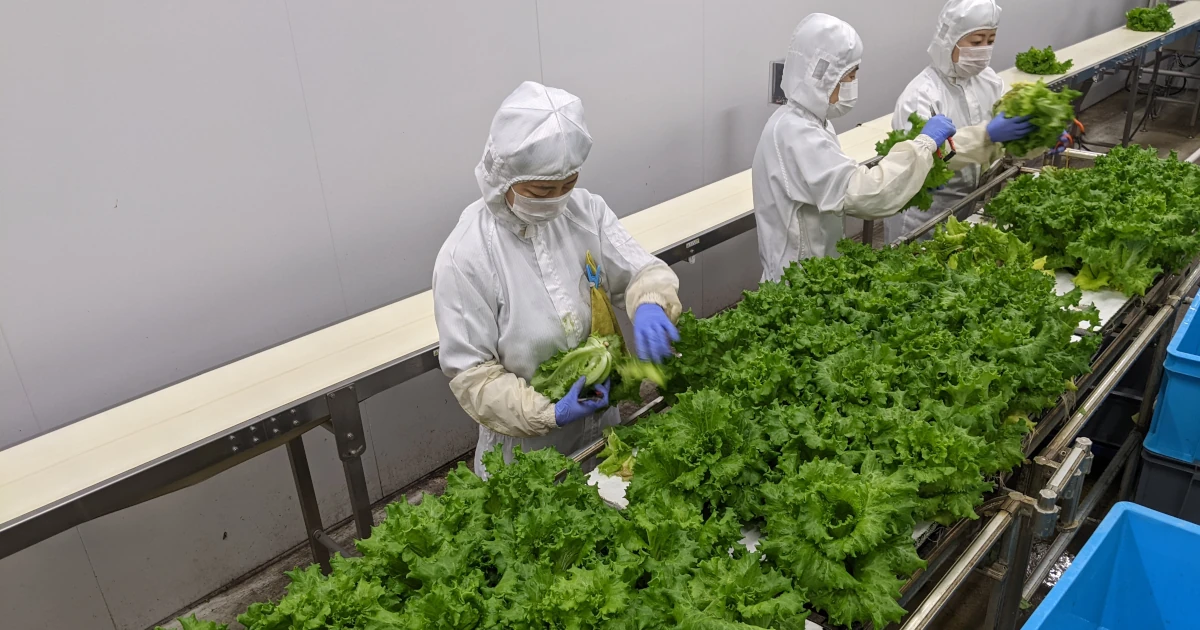
Build a line that cuts fast, and by the time the leaves reach the shelf the tips are bruised. Ease off so they don’t bruise, and now the day’s yield falls short of target—you’ve surely felt this, where propping up one side collapses the other. But it only looks like a binary because you’ve put efficiency and quality on a single scale. Once you separate when you cut, how you move, and what you cut with, you gain more moves. In practice these are tangled together inside the day’s flow, but look at them first as separate dials and where you can actually intervene starts to come clear.
I’ve worked on leafy-green harvest in a PFAL vertical farm for more than ten years. What follows separates two things: what I’ve watched happen on the floor, and what the literature backs up at the mechanism level.
Harvest is not an efficiency-or-quality choice
Cut fast and quality drops. Work carefully and it costs more hands and more time. The harvest floor mostly lives inside this tug-of-war, and the conversation tends to drift toward which one to pick. But look closely at harvest—when you cut, how you move, what you cut with—and don’t you start to see several dials you can turn separately? Even setting aside the big levers like light and temperature for now, working only with what you can move on the floor today, the story isn’t a single “speed or quality” lever.
And there’s one more thing before you turn any dial: the “floor of quality.” Wash and dry your tools and harvest containers; keep clearing water and debris from the harvest area—for hydroponic leafy greens, this is the foundation that sets quality before the cut even happens. Pack while water is still on the leaves and you’ve built an entry point for mold and rot. This is what I’ve harped on endlessly on the floor: washing, drying, and tidying are free, doable today, and forgiving of mistakes. So they’re also the first dial you can turn. Talk about the cut or about nitrate while this stays loose, and you’ve still got no solid ground under your feet.
Take the time of day, for instance. On the floors I’ve worked, fatigue would set in by the afternoon, and what got cut would later turn up at the boxing stage with rough cut faces and uneven lengths. From the start of the shift through midday, by contrast, focus still held—hands moved fast and stayed uniform. That said, which part of the day gets rough differs by site and by person. There must be floors where hands and eyes are cold first thing, and the first hour is the roughest. So rather than deciding the time of day in advance, watch when your own floor gets rough and tilt that stretch toward uniformity—that’s what matters. The point is simple: if the state differs by time of day, split your aim.
If the roughness comes from when you cut and how you move not meshing—tired, or not yet warmed up, and trying to cut at full production speed right away—the cut face tends to get rough. Granted, this isn’t only about the person cutting, but here I’ll keep my eyes on what you can move at your hands right now. Once you know the rough band, treat that stretch as a different thing entirely. Turn the speed dial down for now and focus only on getting lengths uniform. When you’re in the groove, you can push the speed up and still stay uniform. Same harvest, but you split your aim by time of day.
What’s interesting is that once quality steadies in the rough band, the speed afterward actually climbs too. With less rework to fix the rough batch at the boxing stage, the downstream steps can run faster. Rather than slamming speed and quality together head-on, decide in advance which to prioritize in each time band. Then there’s a band where both follow on their own. Haven’t you had that experience?
How you move changes how uniform the cut is
In the afternoon, as fatigue sets in, you’re snipping with just the wrist. Piling the cut heads into your left hand while reaching for the next one, the motion is a little awkward. But in the morning, when you’re in good form, you turn the whole arm—the whole body—to face the head. Same person. That “how you move” is what acts on how uniform the cut comes out.
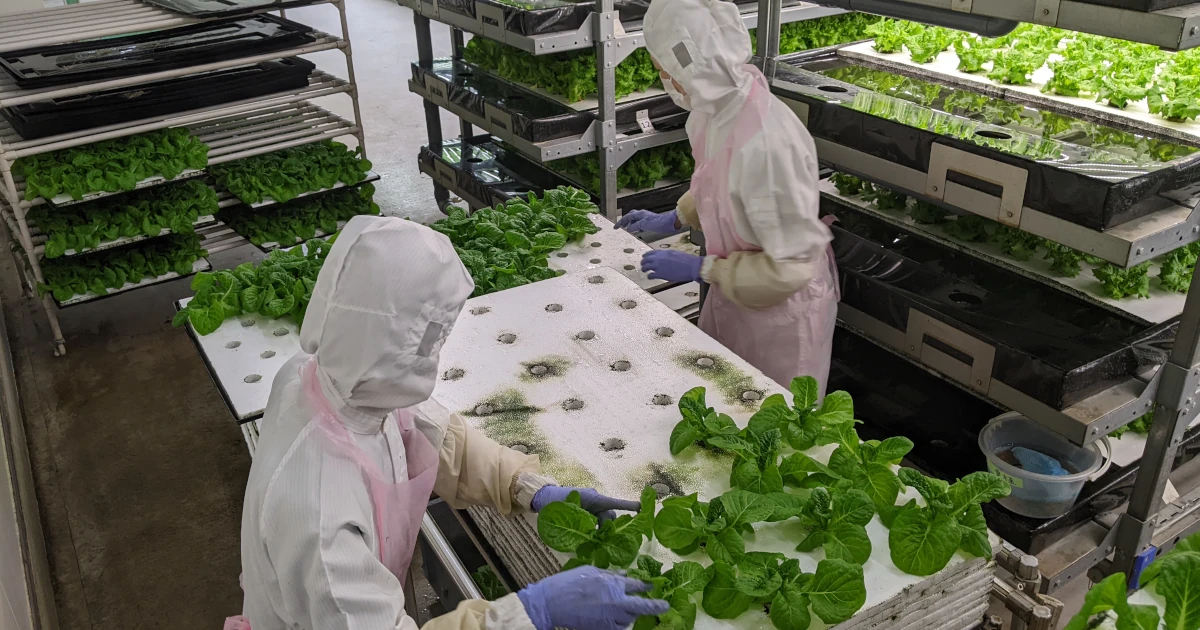
Wrist-snipping gets rough probably because the cutting range is too wide and you’re reaching for distant heads with just your hand. So when you move heads to a bench or conveyor before processing them, set the bench height so the elbow bends slightly and narrow your reach to within a single step. Cut only what’s within reach, then bring your whole body closer. Do that and the angle the blade enters at lines up every time, so the cut faces don’t scatter—something I’ve seen borne out again and again on PFAL leafy-green floors. That said, the study I’ll touch on later measures only the postural load; whether the cut comes out uniform is my own read from there on.
That the postural load itself drops has been reported. A study that did three-dimensional motion analysis of leafy-green harvest in a vertical farm found that, compared with standing or a 75 cm bench, sitting with the bench matched to elbow height and narrowing the work range reduced the angle of neck extension, the angle of forward shoulder reach, and the distance the center of gravity shifts forward. In the easiest seated posture, neck extension was around 22 degrees and shoulder flexion roughly 77 degrees, as one cited example. Note, though, that this measured working seated at a standalone bench, and doesn’t carry straight over to cutting in place on an upper tier of a multi-tier rack. Where it applies is when you move heads to a bench or conveyor to process or sort them. And what’s measured is the posture at the very moment of cutting—it doesn’t speak to the work speed itself, or to whether prolonged work injures the body. Even so, it clearly lines up with the direction that reaching out with just your hand breaks your posture (see 1).
What you cut with is less about the tool than the steadiness of the motion
Next is “what you cut with”—the tool. Cutting leafy greens, some people use scissors, others draw a knife-like blade through in one smooth pull. Haven’t you noticed this—rather than scissors-versus-blade deciding uniformity, for both it’s whether the blade enters at the same angle and the same spot that does the work. Scissors fix the closing point more easily, so lengths come out uniform. The cut face is sometimes smoother when you draw the blade through. It’s less about the tool itself than about whether that tool lets you keep the motion steady. It’s not that one is superior—the idea is to pick whichever fits your own motion path.
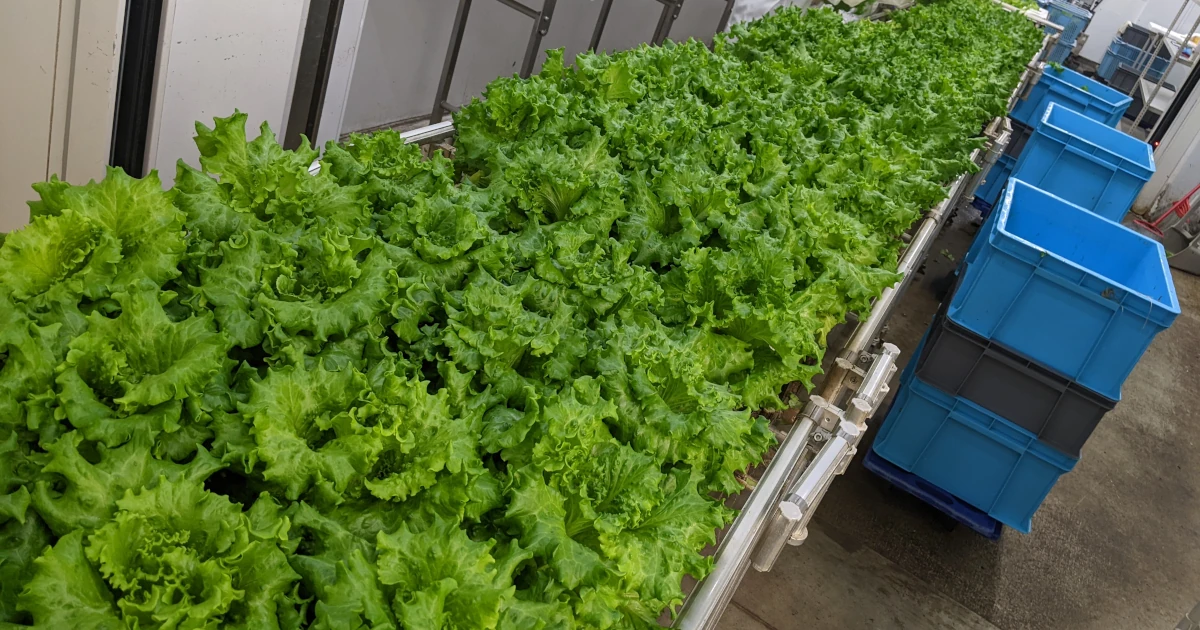
And around the tools, one more thing ties in: hygiene. Knives, scissors, harvest containers—wash and dry them promptly after use. This isn’t only to keep the edge sharp; it’s a floor-level basic for cutting off the contamination you don’t want to bring into hydroponic leafy greens.
When you cut is set by the day you cut and the prep before it
The last dial is “when you cut.” I’ve covered the time of day. But there’s also something that acts at a slower pace—the “day you cut”: which day you cut on, and what you set up in the few days before cutting.
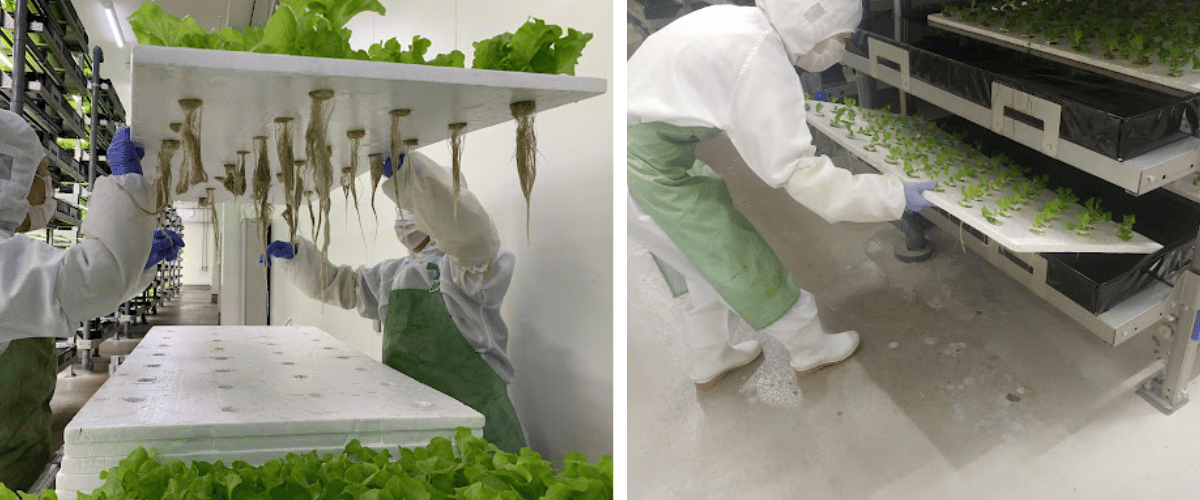
You shift the planned harvest day by one day, and where the day before had small heads mixed in, the next day they’re uniform, and both cutting and boxing wrap up smoothly. Haven’t you had that experience? But if you only shifted a day on a hunch, it doesn’t become a procedure you can reproduce. Head uniformity is in large part already set by final planting density and the upstream steps, and further back still by germination uniformity—but here I’ll narrow it to what the cutting side can do.
For leafy greens like lettuce, the last few days of how you feed them stay behind in what’s inside the leaf. Cut back the nutrient solution or fertilizer a little before harvest, and the nitrate built up in the leaf—a compound thought to be one cause of harshness and bitterness—tends to come down. How you apply light and temperature—the environmental control side—also tunes leaf firmness and shelf life. But since the effect varies by crop, by cultivar, and by the growth at that moment, there’s no blanket answer for how many days ahead and by how much.
For PFAL leafy greens, there’s a report that confirmed this quite concretely. In butterhead lettuce grown under artificial light, managing nitrogen by quantity dropped yield slightly, but the heads still grew to a marketable size while leaf nitrate came down (see 4). So it isn’t that “cutting back costs no yield at all”; the way I’d put it is “yield can drop slightly, but there’s a band where market grade holds.” The likely reason is that the leaf is mostly already built, and the final stage is just tuning what’s inside.
That said, I’ll lay the tug-of-war out honestly here. “Nitrate alone drops while yield holds” can’t be claimed unconditionally. In hydroponic mizuna, there’s a report that stopping fertilizer before harvest brought nitrate down but consistently lowered yield (fresh and dry weight). In another study, switching the nutrient solution to tap water before harvest dropped nitrate sharply but, in one case, lost vitamin C. So whether it drops or not, and what you give up, splits by crop, growth stage, and season. The safe stance is to test once on your own item to confirm.
The greenhouse research backs this up too. In greenhouse NFT lettuce, stopping fertilizer 2 to 4 days before harvest dropped leaf nitrate by an average of 29 to 58% and cut fertilizer use by 7 to 16%. In the spring trial, stopping 2 days before harvest dropped nitrate by 20 to 36% with no loss of yield (see 2). This is a greenhouse result, so one of its premises doesn’t hold for PFAL. Because greenhouse light varies with the season, the source carries a seasonal caveat: in poor conditions in autumn or winter, it doesn’t work the same. In a PFAL, by contrast, you can hold lighting steady on a schedule, so it’s less a story of the effect wobbling by season than one of timing—when you switch off or dim the lights, and how that moves your electricity cost.
On tuning what’s inside, there’s one more. In lettuce grown under natural greenhouse light, applying continuous light for about 72 hours right before harvest dropped nitrate while soluble sugars and vitamin C actually rose, one report found. A clear inverse correlation was seen between nitrate and these compounds (see 3).
Let me draw one line here. Even within “when you cut,” choosing the day and time of day can be moved on the harvest floor that same day. The nutrient solution and light prep just mentioned, by contrast, aren’t something the harvest crew can move alone—they’re a step-earlier setup you hold together with the crop schedule side. So instead of “look at the heads the day before and decide,” put it into a procedure: “starting this many days before harvest, change feeding this way in consultation with the growing side.” That turns the hunch into a reproducible procedure.
Telling the overlapping band from the band where the tug-of-war remains
Set the hygiene floor, then work the day you cut, the motion path, and the tool separately, and there are places where quality comes up without giving up much speed. That’s how it’s looked so far. This is the “overlapping band.” But not everything both holds.
There’s a band where they both hold, and a band where the tug-of-war remains. I’d start by turning the cheap dials first. Hygiene, choosing the day you cut, the motion path, and the tool can be moved today at no cost, and they’re reversible if you fail. Work these all the way and quality and speed both come up more than you expected. Where the tug-of-war remains is usually the side that touches what’s inside the crop directly, like light or nutrient solution. There, on the premise that gaining one means giving up another, you pick the single aim your shipment destination is happiest with.
How you apply light is the textbook case. Raise the share of blue light in red-blue LEDs and lettuce fresh and dry weight falls, while pigments like anthocyanin and phenolics actually rise—that’s the reported tendency (see 5). Yield and nutritional value point opposite ways: squarely a band where gaining one means giving up the other. Unlike the overlapping band, here you choose by which one your shipment destination prefers.
Post-harvest handling re-decides quality after the cut
Once you’ve finished cutting, there’s another job. Trimming, sorting, and packing are the steps that re-decide, at the end, the quality you worked to set. Trimming removes damaged outer leaves and the base, but remove too much and the saleable weight drops straight down—it pushes the marketable yield (packout) down. For sorting, set size and quality standards in advance and grade by them, and the judgment won’t waver from person to person. And before packing, leave no water on the vegetables or the packaging. Water is an entry point for mold and rot, so thorough drying is the premise.
How far you work this post-harvest handling, and how you build the shipment’s look and shelf life, is covered in depth in shipment quality. Here, as an article about harvest quality, I’ll just fix the order: the tuning at the moment of cutting sits on the footing of post-harvest handling—trimming and water management.
Work the operation tight before you consider equipment and automation
There’s one more line I want to draw. The hygiene, motion-path, and cut-day tweaks I’ve just covered are floor operations—within the range you can move through daily farm operations management. Going beyond that to touch the rack build itself, or to bring in automation machinery, is a different decision.
Consider equipment only after you’ve worked the operation tight and hit a ceiling. In the context of improving an existing floor, that order is fine. Automation machinery, seen on tours or in experimental data, looks like it’s working brilliantly. But that level of effect is, more often than not, what shows up only after being fitted to that scale, that cultivar, that set of conditions. Mapped onto your own facility’s shelf layout and economics, it won’t necessarily work the same way.
Granted, the order isn’t fixed to one path. In regions where hiring is hard, or when launching a large new build, there’s a case for weaving labor reduction in from the design stage. I’ve supported PFAL facility launches, and there are certainly situations where building for low labor from the start works better than trimming labor through operations afterward. But even then, one thing doesn’t change. The premise for machines to work—uniformity on the side of the plant being cut, built through operations—comes first regardless of order. Put a machine on non-uniform material and the machine won’t make it uniform.
In fact, the way the research is written quietly backs up this “uniformity first.” With a transplanting robot, for instance, the weaker the seedling’s root establishment, the lower the transplanting success rate, and the paper recommends securing at least a 90% rooting rate. In the measurements, a 92% rooting rate reached a success rate in the 96% range, while at a condition where the rooting rate fell to 46% the success rate dropped too. The result: it’s governed by uniformity on the plant side more than by the machine’s build (see 6).
On automation itself, the review makes two points at once. It states plainly that expecting to automate agriculture wholesale is unrealistic, while the same review also says an autonomous rig built with a simple-axis manipulator could be faster and more efficient than the expensive dedicated machines in use today (see 7). So it’s only wholesale full automation that’s unrealistic—it isn’t denying partial automation. Which is exactly why the order makes sense: build uniformity through operations first, then hand the parts that work on uniform material over to a machine.
Whether that investment pays off also depends on how much of labor cost harvest takes up within cost by line item. Harvest and post-harvest are the steps that take up the bulk of labor cost. So the few seconds you save here ride directly onto labor cost at daily-output scale. For a farm shipping 10,000 heads a day, for instance, shaving just one second off the work time per head works out to roughly 3,000 yen off the day’s labor cost. That matches my own feel from watching labor cost on the floor. For where harvest labor cost sits in the line-item weighting, see cost by line item; but it’s worth carrying the tactile sense that the few seconds here tie straight to money.
What looks like a skill gap, and what design can raise
Finally, one realization remains. When harvest volume or quality differs between a veteran and a newcomer, you tend to write it off as “that person’s skills aren’t there yet.” But given everything so far, it might not be a skill problem at all—just that the bench height doesn’t fit, the cut-day procedure isn’t uniform across people, or the hygiene procedure was never written down and shared.
Here I’ll split two things. Design—bench height, the cut-day procedure, hygiene and post-harvest procedures—raises the “floor” for veterans and newcomers. Hand the procedure out on a single sheet and the newcomer’s minimum line rises. The “ceiling,” meanwhile—a skilled worker’s output, the read on difficult moments, the calibration of force—is decided by skill. Leveling the design doesn’t erase it, nor should it. Judgment that only comes from years of accumulation does remain.
Confuse the two and you waste something. Write off a step you could actually fix with design as “that person’s skills aren’t there yet” and you miss a gap a single sheet could have closed. Swing the other way and dismiss the floor that design can raise as “skill is irrelevant,” and you make light of the veteran accumulation that genuinely works on the floor. So raise the floor with design first, and only then call what remains skill. That’s the order.
Summed up as a procedure, the order to review isn’t that complicated. Hygiene: wash and dry tools and containers, and clear standing water from the harvest area. Motion path: when you move heads to a bench or conveyor, match the bench to elbow height and narrow your reach to within a single step. Tool: whether scissors or a blade, line up whether it enters at the same angle and the same spot. Timing: choose the cut day and time of day on the floor, and hold the pre-cut nutrient solution and light prep together with the growing side. Post-harvest: don’t over-trim, and leave no water before packing. Just put these on a single sheet and hand it out, and the floor starts to rise—and you can keep floor know-how as organizational knowledge rather than individual craft.
And which one you prioritized isn’t settled on the harvest floor alone. Prioritize speed and let the cut go rough, and that damage bounces back into post-harvest shelf life and the shipment’s look. Prioritize quality and let harvest run late, and it hits labor cost and shipment timing. So the safe way to set priority is to look not just at the single harvest step but through post-harvest and shipment.
Look at harvest through the single scale of “fast or careful” and everything starts to look like a binary. But set the hygiene floor, then look at when you cut, how you move, and what you cut with as separate dials, and an “overlapping band”—where quality comes up without giving up much speed, within the range you can move today at no cost—comes into view. At the same time, a “band where the tug-of-war remains,” like light or nutrient solution, where gaining one means giving up another, is honestly there too. There, pick the single point your shipment destination is happiest with. And only after you’ve worked the operation tight and the ceiling is in view, consider equipment and automation. Go in this order and the view becomes: design raises the floor, and the ceiling that remains is decided by skill.
Improving the harvest step ends up acting on the whole farm’s profitability. If you want to work through what you can do on the floor one piece at a time, see also 172 hints for raising a vertical farm’s profitability.