Farm Operations Management
Plant Factory Transplanting: Density Sets Labor and Yield
Articles for Farm Operations Managers
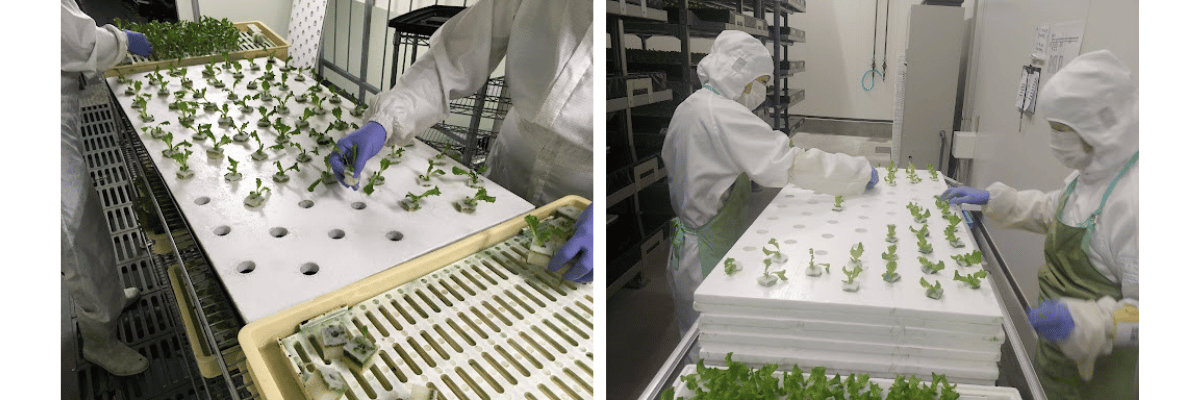
At final planting, are you deciding “how many plants per square meter” by the convenience of the moment — can I plant fast, will I avoid losses? In truth, how tightly you pack the plants (the density) decides how much “weight that meets spec and can be sold” you end up taking at the very end. And the awkward part is this: even if you pack the plants tighter, the saleable weight does not go up. The density you thought was a work setting in your hands was really the entrance to shipment.
To be clear, what I am talking about here is density for “heading leafy greens or large-head leafy greens that ship on the finished size of a single plant (the per-plant weight).” For items sold by count or total mass, like baby leaf, you are far less exposed to the loss of a plant falling below spec, so the right density sits further toward the packed side, and the conclusion I am about to lay out — “packing too tight is a loss” — does not apply as is. Even there, though, it is not simply the case that tighter is always better; in the end the optimum is set by the balance between growth and packing. Pack tighter and each plant’s growth drops, the mass per unit area eventually plateaus too, and quality and harvestability break down. It is just that the balance point differs by item.
Final planting density decides even the saleable weight per shelf
When you are planting seedlings nearly every day, your eyes inevitably turn to “faster, fewer losses.” How many trays can one person get through; how few do you drop at establishment. That yardstick itself matters. But density alone — “how many plants per square meter” — is the one thing that, if you decide it by that sense of speed, quietly shaves down the ease of harvest and the saleable weight per shelf further down the line. Let me unwind, step by step, why a single density variable ends up deciding the harvest effort and the saleable weight in one unbroken stroke.
Density has a “roughly this” number set per cultivar, more or less. But a stand planted on the tight side of that number takes more effort later when you harvest. The leaves of neighbors interlock, and you end up parting the outer leaves to find the base, so the time spent on each plant creeps up. Planting feels good because you can pack fast, but your harvesting hand has slowed. And the shelf you packed tight looks dense and seems like it should yield well, yet each plant comes up small, and when you weigh them, the “plants that reach the target size” turn out to be fewer than you thought. The spacing you plant at carries through not just to the convenience of the moment but to the weight you finally weigh and sell.
When you pack tight, “harvest is slow” and “fewer plants reach spec” look like two separate complaints, but they sit on the same single line. Planting spacing comes down to three things that matter in operation. First, how tightly you pack the work; second, the light-interception area each plant can secure; third, the gap your hand fits into when harvesting. With the one act of packing, these three move in lockstep. So whatever you gained in easy speed at planting gets pulled right back out of the light-interception area and the harvest gap.
Let me start from the “saleable weight” side. The amount of light raining down onto the shelf does not increase even when you raise density. In the end, that fixed amount of light is just being shared out among the number of plants. Add more plants and each plant’s share drops, so it comes up small. This is the easy place to go wrong: the total harvest per unit area (the gross weighed mass) actually keeps rising up to a certain density as you add plants. In fact, in experiments comparing different plant spacing for lettuce in a PFAL, the denser the planting, the higher the yield per unit area. What plateaus is not the total but the “weight that reaches the target finished size and can be shipped as spec — the saleable weight.” Pack tighter and each plant comes up small, and from some density it starts to fall below the target finished size. When you weigh them, the total is there, yet fewer plants meet spec, and you lose on saleable weight. When a shelf looks packed but the “usable weight” is not climbing, that is usually the sign that this effect — “more small plants that fell below spec” — is showing through. And on top of that comes the effort of parting outer leaves at harvest and the erosion of the usable rate we will look at later.
The slow-harvest side is the result of you shaving away the gap yourself. Leaves interlocking means you packed tight enough that a neighbor’s leaf tips intrude into the next plant’s territory. The motion of parting the outer leaves is time spent “reclaiming the missing gap by hand.” Even a few seconds per plant adds up to a sizable labor load once you stack it across shelves and days.
So density is better decided in the order of “pulled back from the harvesting side and the saleable weight per shelf,” not as “the upper limit on the planting side.” First set the target finished size of a single plant and the gap the harvesting hand fits into comfortably. Work backward from there to decide the spacing, and settle on the planting speed last. The next thing to try: put your usual density and a density opened up one notch side by side, same cultivar, and measure just these two — the weight that reached spec per shelf, and the seconds per plant at harvest. The scene where “packing tighter loses at the shelf” should come into view sooner than you expect. Which density band the spec-failures start to bite at moves with the crop, cultivar, and light level, so whether your own floor’s standard density sits before or beyond that point can only be confirmed by this side-by-side.
One thing here, so you don’t mistake it for a similar physics. Some operating variables on a vertical farm behave like this: there is a just-right range, and past it the effect dulls or reverses. Nutrient solution flow rate is like that: a moderate speed is just the right stimulus for the roots and lifts growth, yet too fast and the roots tighten and lose surface area, so growth itself actually falls (see 1, 2). Nutrient solution salinity (EC) is similar — up to a certain range yield does not drop much, yet once EC gets high, yield falls off sharply (see 3, 4). But density works differently from these. Flow rate and EC, once past the optimal zone, lower growth and yield themselves (the total per unit area), whereas with density the total per unit area keeps rising for a while, and what bites is a different exit: “each plant falls below spec.” So the harm of over-packing shows up not as a plateau in total but as spec-failures, harvest effort, and the usable rate. If you read density by analogy to pushing flow rate or EC too far, you’ll get this wrong.
What decides density is not the cultivar but light and finished size
Density is set per cultivar — or so you’d think. Think it through, and that number is set less by the cultivar than by how much light is reaching the top of the shelf and what size you want to bring that plant up to. That said, “how far you can pack” does shift with the leaf posture of the cultivar (I cover this in the second half). See it in two tiers: light and finished size decide it, and leaf posture draws the limit.
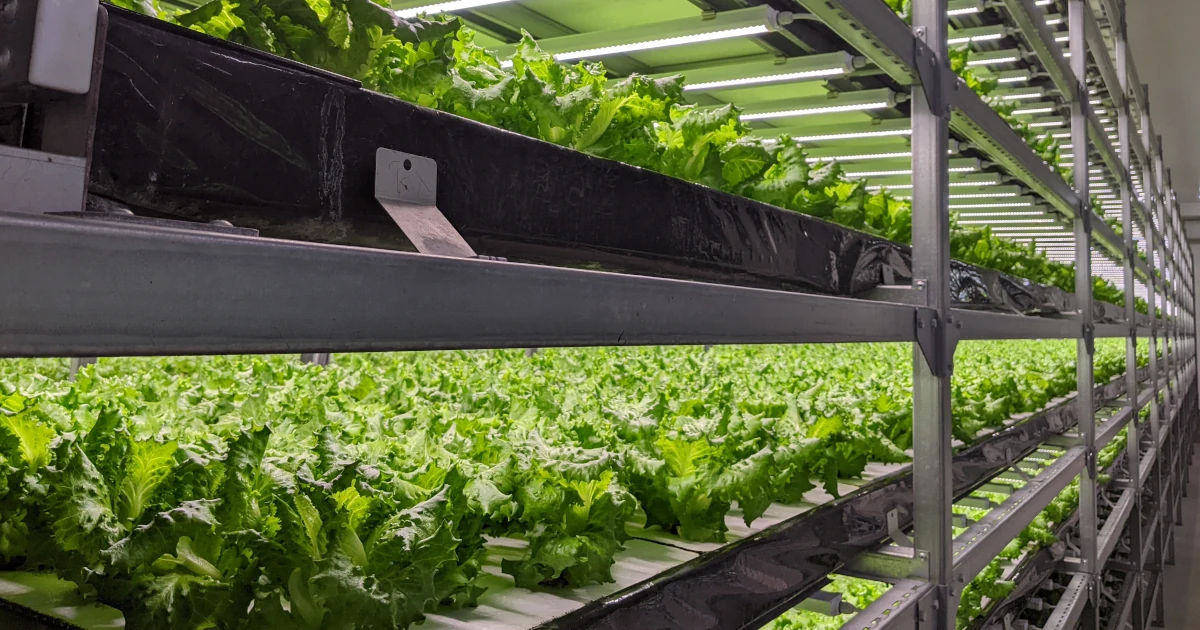
In a PFAL this is, if anything, simple. Light is nearly constant year-round under LEDs, so “the light changes with the season, so change the density” never comes up. And racks are normally designed on the premise of fitting the same panels at the same height on every tier, so light is uniform regardless of tier. So density too should not, really, become a matter of finely apportioning it tier by tier. The right line is: from the target size and the light that, by design, should be reaching every tier, set one standard and hold it across all tiers.
What snags you is more likely the observation that “even planting at the same spacing, the top tier and the bottom tier come up a little differently.” But the culprit for that difference is usually not light. Since light is made uniform by design, what remains and bites is unevenness in temperature and airflow — heat tends to pool on the upper tiers, and the way air and CO₂ circulate is not even across tiers and positions. (If anything remains on the light side, it is less a tier difference than plants at the panel edge being weaker than the center on the same tier, or panel aging or height drift.) So if one tier always comes up small, the first thing to suspect is temperature or airflow, and that is fixed with the environment and equipment, not plant spacing (more below). Try to make up for it by tweaking density tier by tier, and managing final planting and the panels turns fiddly while the crucial cause stays untouched.
This “if the place is not uniform, neither is the take” shows up not just as a feeling but, when measured, as a difference you cannot ignore. In an experiment examining airflow unevenness in a closed chamber, the central tray sat in stronger airflow — past the optimal zone — so its dry weight came out on average 33.5% lower than the sides (see 5). Fix the airflow to be uniform and the tray-to-tray scatter clearly shrinks. This is a single value from a research chamber, but the direction — “the real identity of a tier difference is more often temperature or airflow than light, and it can be recovered by making things uniform” — overlaps cleanly with the tier differences on the floor.
See it not by plant count but by the circle each plant spreads
The urge to pack tight. Doesn’t it feel familiar? Even when your head knows to “work backward from the target size to set the spacing,” your hands on the floor get pulled toward “pack a little more and you earn more plants.” You want to settle the books with plant count. But that “just a little more” usually loses on the saleable-weight side.
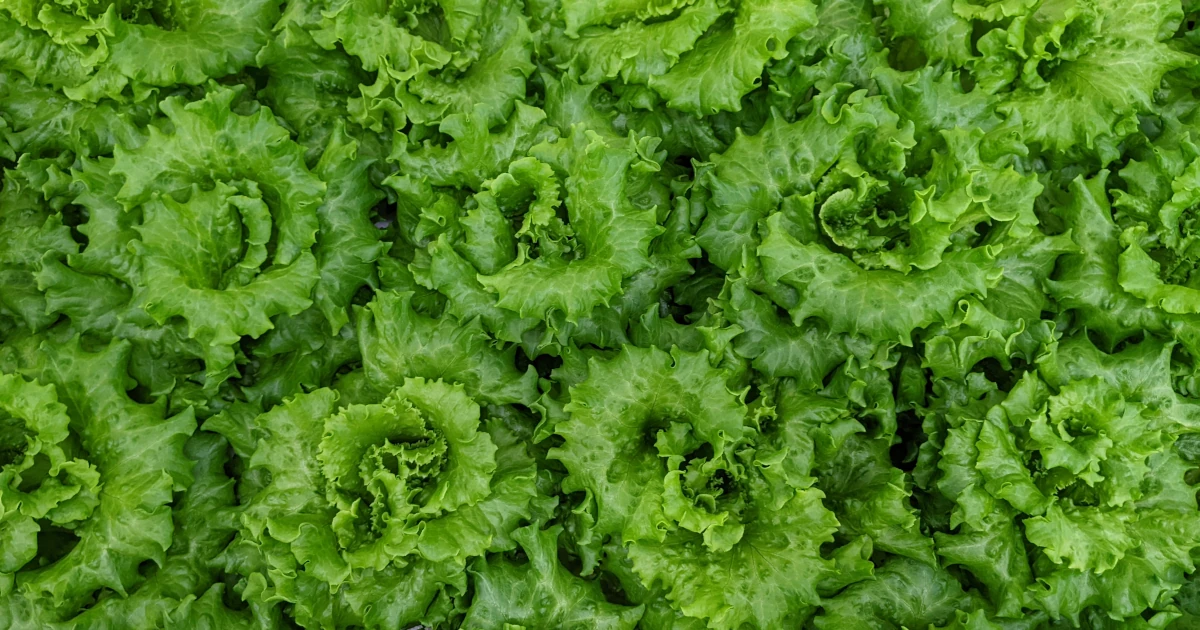
The reason you “want to pack tight” in the first place is that plant count comes out as a visible number at the moment of planting. How many plants you planted you can count on the spot, but the harvest seconds and the weight that reached spec don’t come out until much later. The structure is set up so you decide by looking only at the near number. So you need a guide in hand to keep the later weight and effort in mind while planting.
Plant count comes out instantly; weight and seconds come back later. That very time lag is the real identity of “wanting to pack tight.” You are just being led by the number right in front of you — you are not being greedy.
What’s good to keep in hand is not plant count but the image of “the circle each plant spreads.” When you plant, picture, plant by plant, the circle of leaf spread at the target size, and watch only how much that circle overlaps its neighbor. When the circles collide and start biting into each other, you are borrowing against the future on both fronts: “fighting over light and falling below spec” and “the harvesting hand can’t get in.” You are translating the forward-looking number of plant count into the backward-looking number of area.
If you want it left as a physical object, draw one circle on the final planting panel with the same diameter as the leaf spread at the target size. Each time you plant, compare that circle against the plant spacing in front of you. If it’s tighter than the circle, it becomes a marker that tells you at a glance you’re borrowing against the future. Even if the panel has a fixed hole pitch and you can’t move it on the spot, it becomes a guide for deciding which hole pitch or which panel to use next.
The feeling that “pack tighter and you earn more plants” is, when measured, betrayed in reverse. Pack more plants in and you are only dividing the fixed light still more finely. Each plant comes up even smaller and falls below spec, the saleable weight per shelf does not rise, and if anything only the time spent parting outer leaves at harvest goes up. That is why the side-by-side is worth doing precisely on the shelf where you most “feel like you could go a little more” and want to pack. Once it shows in numbers that “settling the books with plant count” doesn’t add up on saleable weight per shelf, the habit of being pulled by the number in front of you starts to loosen.
The point that “time spent parting outer leaves” creeps in is backed up by a case study at a certain vertical farm. There, harvest is cited as the most time-consuming step of all processes. In a six-month observation of the same facility, harvest labor productivity ranged widely from 1.5 to 6.0 kg per person-hour, and how you tighten this up matters (see 6). It is a single-facility case, so you don’t apply the numbers straight to your own floor, but the read — “the harvesting hand carries more labor than the planting speed” — points the same way.
Over-packing shows up late, as the usable rate
When circles overlap, it shaves not only the saleable weight and the harvest effort but the “usable rate” too. Doesn’t this feel familiar? Pack tight so the leaves interlock and air (the airflow that promotes transpiration) struggles to reach the inside of the plant, so the tips of the inner leaves wither — a tipburn-like presentation that, in some cultivars, increases. Even at the same density, some cultivars break down easily and some don’t, so the judgment to pack density tighter and the choice of cultivar are things to see as connected.
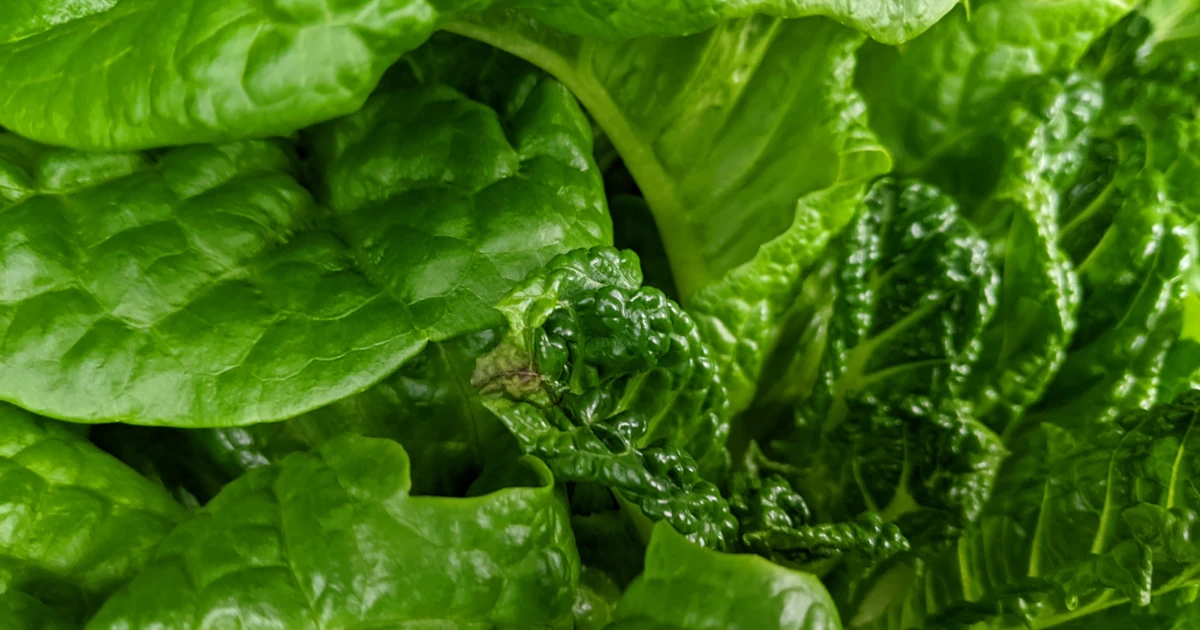
To put one thing honestly on the table: the main factors driving tipburn itself are growth speed (light, temperature), the transpiration that carries calcium to the inner leaves (humidity, airflow), and cultivar difference. It is not that packing density tighter has been experimented on as directly increasing the withering. It is more accurate to see density as one factor that nudges these three conditions toward turning out badly. Even so, it is certain that packing tight so the leaves interlock makes the air at the center prone to stagnating, and in break-down-prone cultivars that is where it bites.
The breakdown in the usable rate when leaves interlock from packing tight is the same phenomenon as “the circles overlapping” from before, at a different exit. When the circles bite in, on top of borrowing against light and the harvesting hand, one more thing — “air (the airflow that promotes transpiration) doesn’t pass through the inside of the plant” — becomes prone to happening. When leaves overlap densely and the plant’s center is blocked, only there does the air stagnate, transpiration stalls, calcium doesn’t reach the inner leaves, and the tips wither (tipburn). So the one act of packing density tighter bites on three at once — the weight that reaches spec, the harvest seconds, and the usable rate — and the usable rate is the exit that comes out the latest of these, and in a lump.
This is where the cultivar difference bites. Cultivars whose leaves stand upright and leave a gap in the plant spacing don’t steam up at the center even when packed somewhat, and they hold up against overlapping circles. Conversely, cultivars whose leaves lie down and fold in, or those that are tipburn-prone to begin with, are weak to packing because their center blocks up easily. There isn’t a study that swung density itself, but in the feel on the floor, withered plants visibly increase past a certain density. So the basic rule is “the more break-down-prone the cultivar, the bigger you read the circle and stop short of overlap,” and for each cultivar you take that circle’s diameter a size larger than for the break-down-resistant ones.
As for how to connect it, the way you measure can stay the same. When you take weight and seconds in the side-by-side, just add one more column: “number of plants withered or discarded.” In break-down-prone cultivars, the usable rate starts to fall before the weight reaching spec plateaus, so for those cultivars set the upper limit not at the weight peak but at “one step short of where the usable rate starts to fall.” Break-down-resistant cultivars you can push to the weight peak. Sort cultivars into about two buckets by “how big a circle you’re allowed to push to,” and the density judgment and the cultivar choice connect on one line.
The read that “pack tight so the leaves interlock and, with no air getting inside, the tips of the inner leaves wither” meshes well with the research on tipburn. Tipburn in hydroponic lettuce is tied to a calcium shortage in the young leaves inside the plant, and that calcium shortage is explained as arising because the calcium carried by transpiration is biased toward the outer leaves and struggles to reach the inner ones (see 7). So even if you add nutrients from outside, they struggle to reach the packed interior. On the other hand, passing horizontal airflow along the grow bed — roughly 0.28 m/s or more — clearly reduces tipburn, while tweaking temperature alone is less effective; and sensitivity differs greatly by cultivar, with a study comparing 28 cultivars finding the proneness to occurrence scattered all over (see 8). The sort of “the more break-down-prone the cultivar, the bigger the circle” meshes with this.
Furthermore, there is a trade-off, reported in multiple studies: push light harder to speed growth, and tipburn gets more likely (see 9, 10).
Separate the range you pack out on the floor from the range you hand to equipment
Up to here has been about the range you can move in floor operation, but there is a level pulled back from that, too. The uneven growth between tiers from before — the bias in temperature and airflow, or the layout and aging of the panels — is holding down the ceiling on the take. Does this situation ring a bell? When that’s the case, plant spacing adjustment can’t fill it, and it becomes a matter that traces back to the HVAC, the blowers, the racks and panel layout themselves — that is, the environment and equipment. And one more thing: when labor cost starts to weigh on you, the talk tends to turn toward “why not just automate transplanting,” but there you’ll misjudge unless you look at it including the installation cost, the maintenance, and the knock-on to the usable rate. How far is something to pack out on the floor at final planting, and from where is it something to lift up as equipment or investment? You need that line, and a realistic expectation of what to hope for when you turn toward automation.
The seam between equipment talk and floor talk can be set as “if measuring no longer raises the peak itself, it’s equipment.” The work of packing density out in the side-by-side is only redistributing the share per plant under the given light and environment. However you move density, neither the total light raining down nor the heat pooling on a tier changes a millimeter on its own. You matched the spacing from the target size, packed the gap and the usable rate cleanly, and still the tier-to-tier difference won’t disappear and the overall ceiling won’t rise. Doesn’t that feel familiar? Once you reach that point, plant spacing can no longer fill it. From there on it’s revisiting the HVAC and blowers, panel height and layout, leveling the racks, the light source itself — a line lifted up to the investment side rather than the floor’s hands. So in order: first measure and pack density out. Only when the difference that won’t fill remains do you hand it up as material for considering equipment. Jump to equipment from the start and you blame on equipment even the portion you could have taken by redistributing.
As for automation, it’s safer to look at it with expectations dialed down a notch. A transplanting machine is certainly fast, but what was deciding the take was not the planting speed; it was the plant spacing and the overlap of circles — that is, the quality of placement. What automation directly affects is “planting speed,” and the light-interception area and harvest gap I’ve been calling the most decisive don’t improve on their own just because a machine plants fast. One thing to supplement here: in PFALs there is also equipment like automatic spacing (two-stage final planting), where the machine widens the plant spacing as growth proceeds, and in that case the machine takes on securing the light-interception area and can hold the quality of placement steady. But with a transplanting machine that sets plants into a grid of fixed hole pitch, fine adjustment like changing the plant spacing to match the cultivar or target size can, if anything, become harder. The point is that the view changes depending on whether the machine can carry even the quality of placement, or just adds speed.
So when you look at automation, compare it including not just the planting labor but the installation cost, the maintenance, and how the take and the usable rate move when density is bound by the machine’s grid — all on the same yardstick of weight, seconds, and number discarded. The planting seconds certainly drop, but if on that yardstick the saleable weight per shelf falls or the usable rate drops, the labor cost you saved is being clawed back elsewhere. Conversely, if there’s a prospect of adding only speed while holding the quality of placement, that’s a sound investment. The point is that automation is about “adding speed only on the premise that you can hold the quality of placement steady” — it is not magic that takes over the optimization of placement itself.
The views “the labor cost you saved is clawed back elsewhere” and “the line you lift up to equipment” are continuous with the research on profitability. PFAL profitability is decided per unit area, and it is moreover very sensitive to market price. For lettuce, one estimate reports that even a slight drop in market price sends the minimum profitable scale jumping by an order of magnitude (see 11). That said, this is a single model estimate set on specific premises — advanced cultivation technology and an assumed cost structure — not the area you yourself must hit on the floor. Even so, the direction — that “how much spec-meeting weight you can take per unit area” governs a thin margin — is clear, and seeing density by the yardstick of shipment weight is consistent in direction with that ease-of-profitability effect. One more thing: density bites not only on the size of a single plant but on the turnover — how many days that shelf is tied up. Just hold the sketch that per-unit-area profitability is decided by the product of density, turnover, and unit price, and you won’t miss. The side of syncing turnover with the crop schedule I’ll leave for another time. Construction cost also has economies of scale, with it said that when scale grows 100-fold the per-unit construction cost falls by an average of 55% (see 11). But this is the story once you’ve lifted to the equipment side, and the order is: first redistribute and pack out on the floor.
All you need to log each day is the one number, shipment weight per shelf
I’ve been talking about measuring and comparing, but many of you surely carry this worry: it’s hectic every day at both planting and harvest, so going out of your way to time seconds or count discards separately won’t last — you’ll do it once, feel satisfied, and stop. Thinking on the premise of keeping it up every day, what is the bare minimum, the one thing worth not slacking on?
Measuring every day won’t last, naturally, so you don’t have to do it constantly. If you log anything, just one will do: “shipment weight per shelf.” The shipment weight I mean here points not to the total harvested but to the weight that meets spec and actually sells. You weigh this at shipment without fail, so there’s almost no new effort added. Not plant count, not seconds — see the weight that finally sells, by the unit of the shelf. That alone lets you look back later on whether the shelf you packed with more plants is winning or losing on saleable weight.
Seconds and number discarded you can demote to tools you “add only when something catches your eye,” not constantly. When there’s a shelf whose saleable weight isn’t climbing as usual, go look at the harvesting hand and the withered plants only then. Day to day, weight as the single line; add the two when something snags — that’s plenty.
The “do it once, feel satisfied, and stop” problem you head off more through the habit of “watching the circle when you plant” than through the count of measurements. Measurement is an occasional answer-check; what bites every day is the instant of comparing the panel’s circle against the plant spacing in front of you. That side has almost zero effort, so it lasts. Log the saleable weight and answer-check occasionally; confirm with the circle every time you plant — carry home just these two, and the floor mostly runs.