Farm Operations Management
Plant Factory Temperature Management: Leaf Temp, Not Air
Articles for Farm Operations Managers
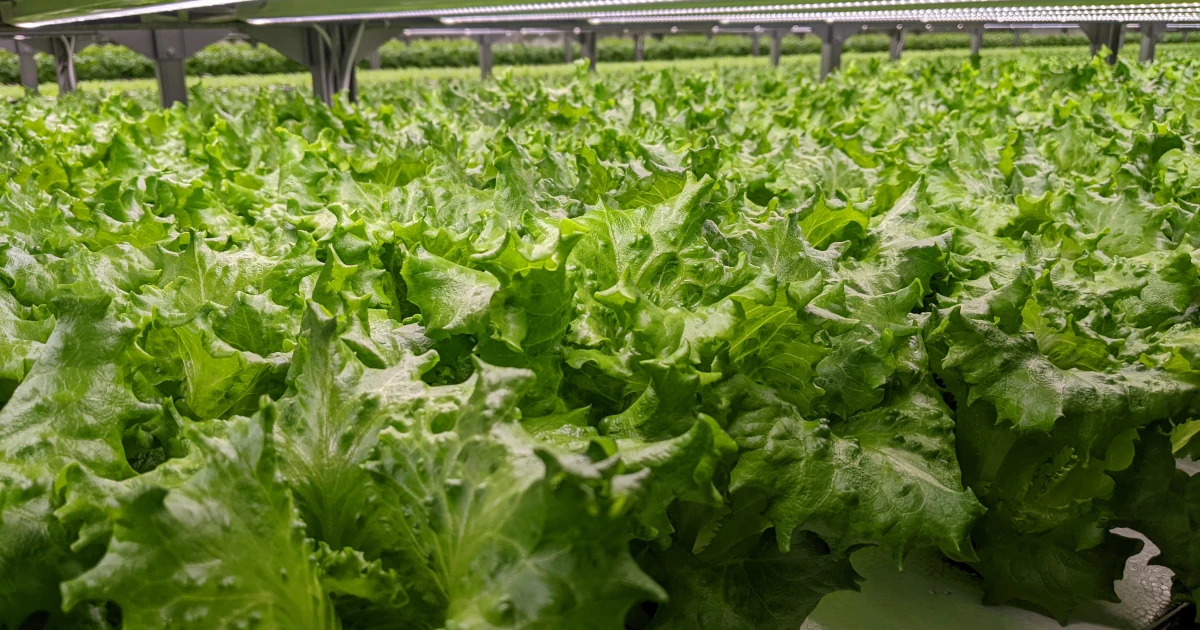
The HVAC is running exactly as instructed. The setpoints, the numbers in the daily log — nothing is wrong. And yet growth varies, summer power is heavy, and how far to drop the night temperature is a fresh puzzle every time. “I’m holding everything, so why?” — that question usually just hangs there, unanswered.
The clue is in where you are measuring the temperature. What we manage is the air temperature, but what the plant responds to is the leaf temperature and the photosynthesis, respiration, and growth tempo happening at the leaf. Here, we will revisit temperature from the side of that physiology.
Reading the gap between air temperature and leaf temperature
vertical farm temperature management is often thought to be finished once you set the setpoints and hold them. So many degrees in the day, so many at night. As long as you don’t miss those values, you’re fine — that’s the idea. But out on the floor, even when you hold the settings exactly, growth fails to line up from shelf to shelf, summer power runs heavy, and how far to drop the night temperature stays unclear — that’s the kind of snag you hit. Holding the settings and getting the crop to respond turn out, in the end, to be two different things.
Take leafy greens fixed at 25°C by day and 18°C by night, running fine overall. Yet on the same rack, growth doesn’t quite line up between the top and bottom shelves. At first you’d suspect how the air hits them, or the distance to the LED. And in fact, even though LEDs are called energy-efficient, about forty percent of the power they draw leaves as heat. There are observations that under high light intensity the temperature rises by about 2–5°C right under the fixtures, and the top shelf tends to trap the lighting’s heat. The setting is 25°C, but the actual leaf temperature ends up higher than on the bottom shelf. So a question arises. Should temperature be watched as the air, or as the leaf itself? The reason things don’t line up even though you’re holding the setpoints usually lies right here.
To state the conclusion first: what the setpoint points to is the air temperature, while what actually matters inside the crop is the leaf temperature. The two usually roughly coincide, so things run without distinguishing them. But when you have a light source like an LED that holds heat at close range, the leaf on the top shelf rises above the air, and that “gap” comes to the surface. A study that varied light intensity and air velocity over leaf lettuce and measured leaf temperature also confirmed that leaf temperature is not the air temperature as-is, but shifts with the intensity of the light hitting it and the speed of the airflow (see 1).
Why does leaf temperature matter more? Because both photosynthesis and respiration are enzyme reactions, and what sets their rate is not the air but the temperature of the leaf itself. Enzyme reactions have a temperature dependence — roughly speaking, a 10°C rise can speed them up to about double. So even at the same “25°C setting,” if the leaf on the top shelf is actually 27°C, then for that leaf the temperature is no longer 25°C. The rate at which the reactions run and the losses from respiration sit at a different point than for the leaf on the bottom shelf. The settings line up but growth doesn’t — that often takes the form of leaves not lining up even when the air does.
So is watching the air pointless? No. The air is what the HVAC can move directly. You watch both, in two stages: air as the “input,” leaf as the “result.” There’s one thing you can do right now. Point a radiation thermometer at the leaves on the top and bottom shelves and measure how many degrees they differ from the air setpoint. On a shelf where LEDs sit close over leafy greens, the top-shelf leaf temperature should read higher than the air setpoint. In my experience I’ve seen a few degrees of difference on the top shelf under close LEDs, but that range moves quite a bit with the facility and how the light is applied, so the first step is to measure your own shelves and have the numbers. Once you know that gap, where to aim your countermeasure — adding airflow to the top shelf only, or lowering the setting a little — becomes concrete.
Incidentally, this gap is large in the daytime when light is strong, and small at night when there is no light.
Night temperature is decided by how much of the day’s sugar you keep
By day the lighting’s heat makes the leaf temperature higher than the air. So what about night? At night the lighting is off, so leaf temperature and air temperature can be treated as roughly equal. That’s because the thing that happens by day — the leaf alone being lifted by the heat of a light source — doesn’t occur. So night is a fairly straightforward window, where the setpoint and the crop’s actual temperature don’t diverge much.
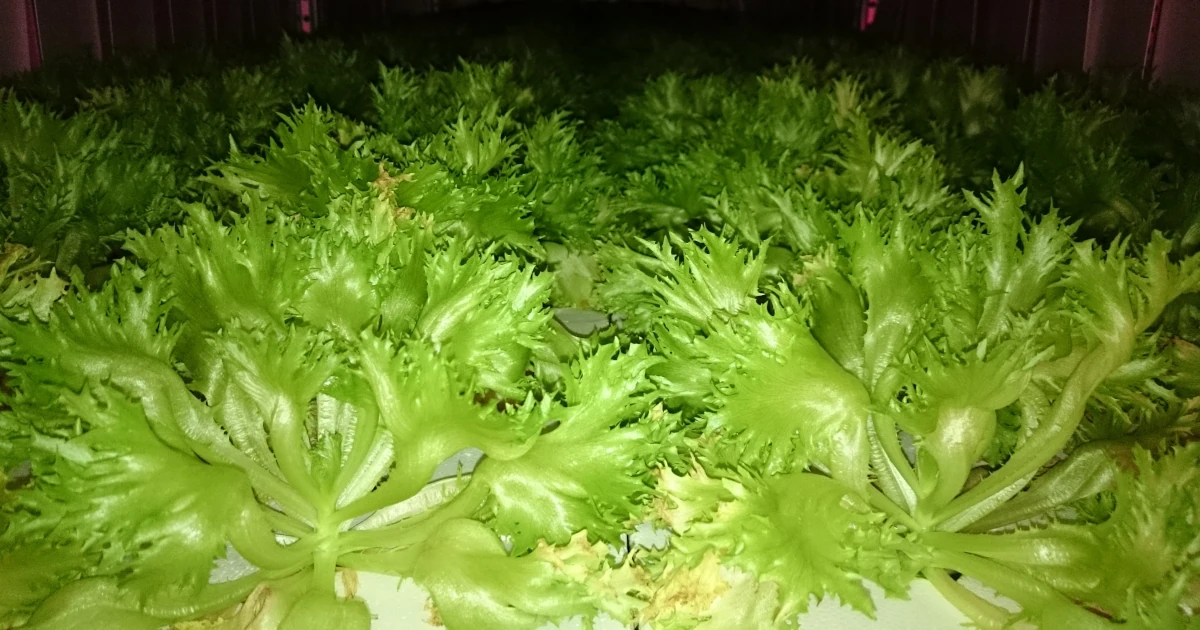
The problem is when you’re lowering that night temperature on a vague sense that “night is for cooling things down,” while the reason for lowering it never quite sits right. The aim makes sense once you think about “what is night the time for?” By day the plant takes in light and makes sugar through photosynthesis. At night there is no light, so no new sugar can be made, and the crop respires using the sugar it stored by day. This respiration is a reaction that speeds up with temperature, and the higher the night temperature, the faster the sugar is spent. Up to here it’s solid as a basic physiological process, and lowering the temperature at night does suppress the sugar loss during the night itself.
But there’s something to watch here. If you blithely tie “suppressing the loss” to “that much more is left over to grow,” you’ll misread the story. When you look at studies that actually varied temperature on leaf lettuce, the direction comes out the other way. Holding the day-night difference fixed at 6°C while raising the average temperature — in night-temperature terms, going from 15°C to 18°C to 21°C — fresh weight actually increased. Depending on the cultivar, one kept increasing from 20°C up to 26°C for an 18% gain, another gained 32% from 20°C to 23°C and then plateaued, and growth was best at an average of 23°C, which in day/night terms is around 25/18°C (see 2). In other words, it’s not the simple story that the cooler you make the night, the more sugar is left and the more it grows in a straight line. Warmer (at least up to around 25/18°C day/night) actually grows better.
So what’s the point of lowering the night temperature? It’s not “saving sugar to boost yield,” but a quality-side adjustment that suppresses legginess and tightens the plant. If you don’t bring the night temperature down enough, the stems tend to stretch and the form falls apart. So it fits the floor’s sense better to think of the night temperature as a lever for tuning “tightness of growth” rather than one for earning “amount of growth.” And conveniently, the growth optimum the studies show (25/18°C day/night) and the night 18°C used on the floor as a benchmark for tightening sit in nearly the same place. So fixing the night at 18°C to start is a reasonable starting point on both the yield and the quality side.
It also follows from this that lower is not always better. Drop it too far and legginess stops, but the tempo of growth also moves toward sluggish. The night temperature is decided by the balance between “tightening” and “growing it properly,” and 18°C is one example of that compromise.
So when you think about night temperature, it’s best to view it together with how much sugar you’re making by day. Dropping only the night when daytime photosynthesis is weak just means protecting something that wasn’t stored in the first place. Conversely, if you’re making plenty by day, the daily balance turns over cleanly. Day and night are not separate setpoints; they’re linked by a daily balance of making by day and spending at night.
Thought of that way, a question arises: does the night temperature have to be the same 18°C all the time? On a day that got plenty of light versus a cloudy day with weak light, what needs protecting at night should differ a little. As a matter of logic, the direction “the weaker the light that day, the more you bring the night down” holds up. But as for whether you push it that far day by day on the floor — first, it’s better to fix it at 18°C so you can read the daily balance. Even if you do change it, a rough rule like “drop it a little when overcast weather persists” is enough to do the job.
A summer 1°C weighs differently by day and by night
In summer, power is pressing. The HVAC power in particular bears down hard, and you want to raise the setting even 1°C to ease that burden at least a little. But you can’t say for sure what would happen to growth if you raised it, so in the end it’s too scary to touch — a common standstill on the summer floor. Seen within the daily balance, what part are you actually touching when you move the summer setting by 1°C?
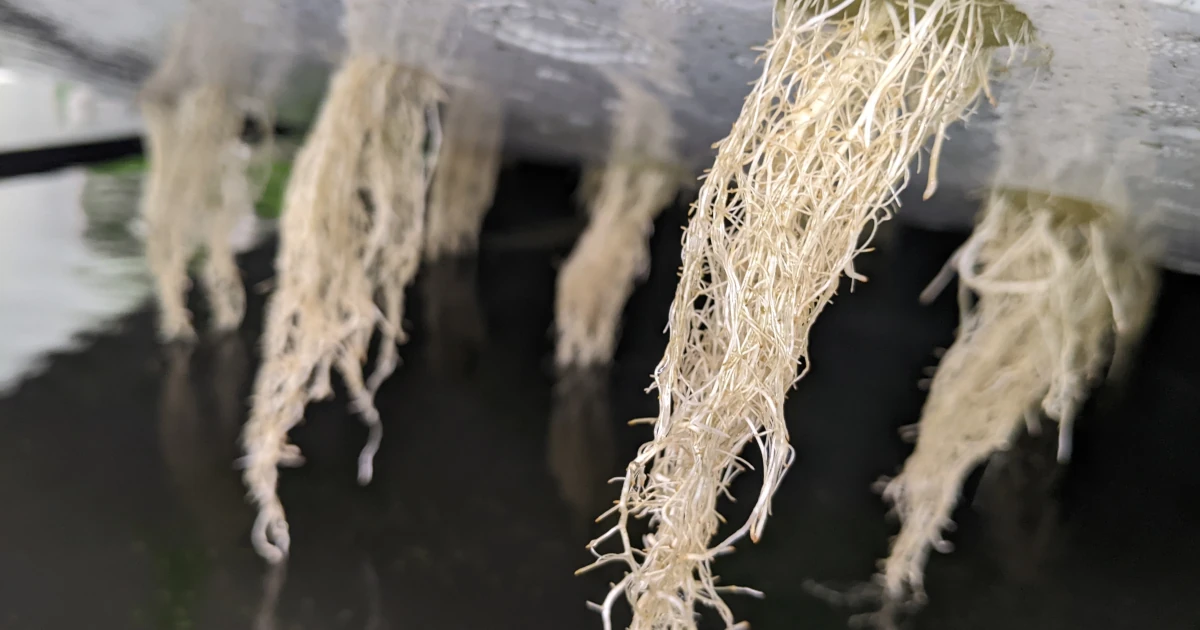
Raising 1°C in summer acts in completely different directions by day and by night. Splitting these apart lets you get out of the “too scary to touch” state.
First, the day. For leaf lettuce, within the optimal temperature range, the effect of air temperature on photosynthesis itself is smaller than you’d think. There’s a framing that what air temperature mainly affects is the developmental tempo of leaves unfolding and leaf size, while its effect on dry weight is small (see 3). So what’s scary about raising 1°C on a summer day is not that photosynthesis suddenly drops. What’s scary is that when high air temperature is compounded by strong light, the quality-side risks like tipburn and a falling-apart form go up. If the setting is 25°C and the top-shelf leaf is already 27°C, then raising the setting 1°C to push the leaf temperature to 28°C pushes the shelf that’s already being pressed hardest even harder, and acts on the side of lowering quality. So the daytime setting is a poor target to raise for the sake of power.
The night, on the other hand. A nighttime 1°C acts on the side of “increasing” respiration losses. Going from 18°C to 19°C advances the over-spending of sugar during the night a little. But as we saw earlier, the growth optimum is around 25/18°C day/night, and easing the night a little doesn’t make growth drop right away. If anything, since there’s a range where “even warmer, up to 23°C, grows well,” there’s room left to ease the night. And from a power standpoint, at night the temperature difference from the outside air is small and the leaf alone isn’t lifted, so it’s a window where the same 1°C makes it easier to lighten the HVAC load.
So the build comes out like this. If you want to hold down power in summer, before raising the day and risking quality, go after two things: holding the daytime top-shelf leaf temperature down with airflow so you avoid extra HVAC, and easing the night temperature a little instead of bringing it all the way down. Rather than fearing a 1°C as “the same 1°C everywhere,” see it split out: the daytime 1°C, close to quality, is heavy; the nighttime 1°C, with room in growth, is relatively light. Do that, and the 1°C you can touch and the 1°C you don’t want to touch get separated out as numbers on the floor.
“High daytime air temperature compounded by light intensity hurts” comes out clearly in studies too. In closed-type lettuce, the stronger the light the faster the growth, but that hurried growth itself is known to be tied to a greater tendency for tipburn (see 4). In the earlier study too, pushing growth faster by raising CO2 increased tipburn occurrence (see 2). And the trade-off — that the conditions for maximizing growth and the conditions for protecting quality diverge — is also known (see 4, 5). So a shelf like the top one, where leaf temperature is high and the light is close, is in a sense “being pressed,” and adding still more heat there hurts most. The design of how far to raise the light can be taken up separately on the photosynthesis integral and PPFD design side.
Whether your settings are right is judged by leaf temperature, day-night difference, and root-zone temperature
As we’ve seen, the gap between leaf temperature and air temperature grows in the daytime when light is strong. Let’s pull back a little here. When you’re managing temperature on the floor, what you most want to know is, in the end, “are my current setpoints right or wrong?” But saying as an absolute value that “for leafy greens, 22°C by day is correct” flattens the differences between facilities. What you need is a framework for judging, from the side of physiology, whether your own facility’s settings are reasonable — for example, how to handle root-zone temperature and the day-night difference.
The measuring stick for the judgment is not an absolute value. It’s the balance up to now — making by day, not over-spending through the night, and growth turning over on the daily net. Concretely, you look through three frameworks.
The first is the gap between leaf temperature and air temperature. Measure how many degrees the top-shelf leaf is above the setpoint, and if that difference stays small, it’s a fair benchmark that air and leaf are roughly lined up. The second is the day-night difference, the so-called DIF. Whether you’re properly getting the difference of high day and low night. If there’s legginess, you can read it as a possibility that the night isn’t being dropped enough (legginess also involves other factors like light intensity and planting density, so temperature is just one of them). The third is root-zone temperature. This is more easily overlooked than leaf temperature. If the root-zone temperature is too high, the roots are worn down by respiration, and the sugar you worked to make gets spent unnecessarily at the roots. Facilities that measure even root-zone temperature may be fewer than those measuring leaf temperature.
So the judgment procedure takes the form not of an absolute answer key, but of measuring the three points — leaf-temperature gap, DIF, and root-zone temperature — at your own facility, and reading reasonableness by whether the daily balance holds.
On root-zone temperature, one example of the “read by difference” view comes out cleanly. There’s a study where, in lettuce, keeping the root-zone temperature about 3°C above the air temperature increased shoot and root dry weight across all four air-temperature bands tested (17, 22, 27, and 30°C). What’s interesting is that what this study compared was two levels — “same as air temperature” and “air temperature +3°C” — and the +3°C came out favorable across every band. The paper itself notes that it chose +3°C as a matter of convenience, so you can’t extend this into a universal measuring stick of “the root must always be air temperature +3°C.” Even so, the picture that the good relationship was held by the difference from air temperature rather than an absolute value is a foothold when you look at whether settings are good or bad from the side of physiology (see 6). Just to be safe, note that this is about deliberately setting the root-zone temperature a little above the air temperature, and the direction of the difference is the opposite of the first framework (keep the leaf-to-air temperature gap small). As for the root’s optimal temperature band itself, another study reports that in lettuce dry weight is maximized around a root-zone temperature of 25°C and growth falls off as it rises to 35°C (see 7). It’s good to watch root-zone temperature in both bands — the one where following the air temperature a bit higher is favorable, and the one where, with around 25°C as the ceiling, growth falls off if it gets too high.
tipburn and legginess don’t map one-to-one to temperature
Before you ever point a thermometer, you’ve surely sensed something from how the leaves look. Tipburn at the leaf tips, stretched legginess, changes in leaf color. Can these visible signs be read as cues that come before measuring temperature? If you knew which sign maps to which part of temperature, you ought to be able to notice it in the leaf before measuring.
But to state the conclusion first: tipburn, legginess, and leaf color all serve as entry points to reading temperature, yet the signs don’t map one-to-one to temperature. That’s the first important thing.
Legginess is relatively easy to read. It can often be read as belonging to the side where the day-night difference isn’t being taken — that is, the night isn’t being dropped enough — and you can consider it one of the DIF signs (but since light intensity and planting density also affect legginess, it’s not a temperature-only indicator). The thread of reading legginess itself back from the symptom to temperature design can be followed separately at the relationship between night temperature and legginess.
Tipburn is a bit more troublesome. Rather than high temperature itself, it appears when, in a window where high temperature and strong light overlap, the delivery of calcium and the like to the leaf tips can’t keep up. It’s the result of light, airflow, and humidity overlapping, not temperature alone. So you must not link “tipburn appeared = lower the temperature” in a single line. You watch temperature as one of the inputs.
In fact, this is backed up quite clearly by experiment too. In closed plant factory lettuce, lowering the daytime temperature barely suppressed tipburn. But applying horizontal airflow steadily at 0.28 meters per second or more greatly reduced its occurrence. As a mechanism, it was shown that the airflow makes the leaf’s calcium distribution uniform — that is, it helps the delivery reach the leaf tips — and it’s even said that there are situations where airflow works better than moving the temperature. The same study points out that the tendency for tipburn also varies greatly by cultivar, so beyond temperature, light, and airflow, the choice of cultivar is also one axis (see 8). Another study reports that raising airflow from 0.25 to 0.75 meters per second reduced tipburn occurrence by 87.3% (see 1).
So it’s best to use the visible signs as an entry point for getting a bearing on “where to go measure.” For legginess, suspect DIF; for tipburn, suspect the overlap of leaf temperature, light, and humidity. From there, you come back around to the same order — measure leaf temperature, DIF, and root-zone temperature, and confirm against the balance.
Here, let me sort out one set of airflow-velocity benchmarks used on the floor. The target band for airflow velocity differs a little by purpose. To break up and even out temperature unevenness within a shelf, around 0.3–0.7 meters per second; to go after suppressing tipburn, horizontal airflow at 0.28 meters per second or more; for continuous operation to prevent condensation, a gentler 0.3–0.5 meters per second — so even the same “circulating air” shifts band by aim. The earlier example that reduced tipburn by 87.3% is the value when raising from 0.25 to 0.75 meters per second. Airflow isn’t something to make uniformly strong; the order is to decide what you’re circulating it for, then choose the band.
Temperature only has meaning within the combination of light, airflow, and nutrient solution
Finally, let me draw one clear line here. We’ve unwound this around where temperature acts in physiology, but as with the tipburn we just saw, situations that don’t close with temperature alone will always come up. Once leaf temperature, light, and humidity overlap, it becomes a separate matter of how to design humidity (VPD), airflow, CO2, and nutrient solution, and trying to find the answer only within the temperature setpoint runs into trouble. That’s where you need to draw a line: keep temperature as the entry point but switch over to designing another environmental parameter — consulting a specialist if needed, and going into the design of humidity and light each.
There’s backing for this. In vertical farm lettuce, a framing has been shown that among environmental factors — nutrient solution concentration (EC), the light recipe, CO2, and temperature and humidity — there are interactions that change how each one acts, and optimizing any single one alone isn’t enough (see 5, 9). Temperature is the same: only once you place it within the combination of light, airflow, nutrient solution, and humidity does it become visible whether the setpoint is working or missing. So the closing line “keep temperature as the entry point but switch over to designing another environmental parameter” is consistent with the observation that you struggle to find an answer by continuing to tweak a single number.
On top of that, there are two practical benefits the leaf-temperature frame brings here. One is how you use airflow. When the top-shelf leaf temperature is high, sending in more cold air to cool the whole air goes in the direction of increasing power, but applying airflow to shed only the heat at the leaf surface becomes an energy-saving lever that lowers leaf temperature alone without lowering the air’s set temperature. Cooling the air and cooling the leaf are not the same. It’s precisely because you read by the leaf that the move of getting by without cooling the air comes into view. The other is the criterion for investment. From the management side, investment in HVAC renewal or insulation is also replaced — not “to make it track the setpoint tightly,” but “to suppress variation in leaf temperature, DIF, and root-zone temperature where it matters to growth.” What to protect is not the air’s number, but how lined up things are in the place where growth is decided.
To sum up the story so far in one sentence: temperature management is not a task that ends inside the HVAC panel; the meaning of a setpoint is decided by where the same 25°C is acting — daytime photosynthesis, nighttime respiration, or the tempo of growth.
If you’d like to grasp the floor’s decision axes, including temperature, a bit more systematically, see also 172 hints to raise the profitability of vertical farms.